
Sailing Services
Sailing training, instructor-led mini sailing skills races and on-board team experiences for companies. Built for complete beginners in groups of 4–150 people, on the Turkish coast including Çeşme, Bodrum, Göcek and the Bosphorus.
Last updated:

Sailing Experience and Dinner
Crew a sailing yacht in teams by day, then gather around the same table in the evening. A meal-inclu...

Corporate Sailing Training
Hands-on corporate sailing training for complete beginners: reading the wind, points of sail, tackin...

Corporate Sailing Adventure
A non-competitive day on the water: sailing, a bay stop, swimming and lunch on deck. Built for mixed...

Corporate Sailing Team
A company sailing team made up of your employees: regular instructor-led training sessions, periodic...
Princes’ Islands Sailing Experience: A Day of Sailing, Swimming and Lunch at Anchor
Princes’ Islands Sailing Experience for company groups: a full day sailing from the Anatolian side,...
Antalya Sailing Experience: Kaleiçi, Kemer and the Taurus Mountains for Groups
Antalya Sailing Experience for company groups: sail from Kaleiçi or Kemer beneath the Taurus Mountai...
Golden Horn Sailing Experience: Old City Mornings, Afternoons on the Bosphorus
Golden Horn Sailing Experience: meet on the Golden Horn–Karaköy waterfront, sail past Seraglio Point...
Istanbul Sailing Experience: Bosphorus, Marmara and Sunset Sails for Groups
Istanbul Sailing Experience for company groups: Bosphorus sailing under the bridges, open water on t...

Çeşme Corporate Sailing Program
Mini sailing skills races, sailing training and experience sails on the Çeşme–Alaçatı coast, where t...
Bodrum Corporate Sailing Experience
Corporate sailing in the sheltered water of the Gulf of Gökova: low waves, many bays, day-trip or ov...

Spring Sailing Opening Week
An April–May programme that turns the season's first sail into a corporate event: below summer cost,...
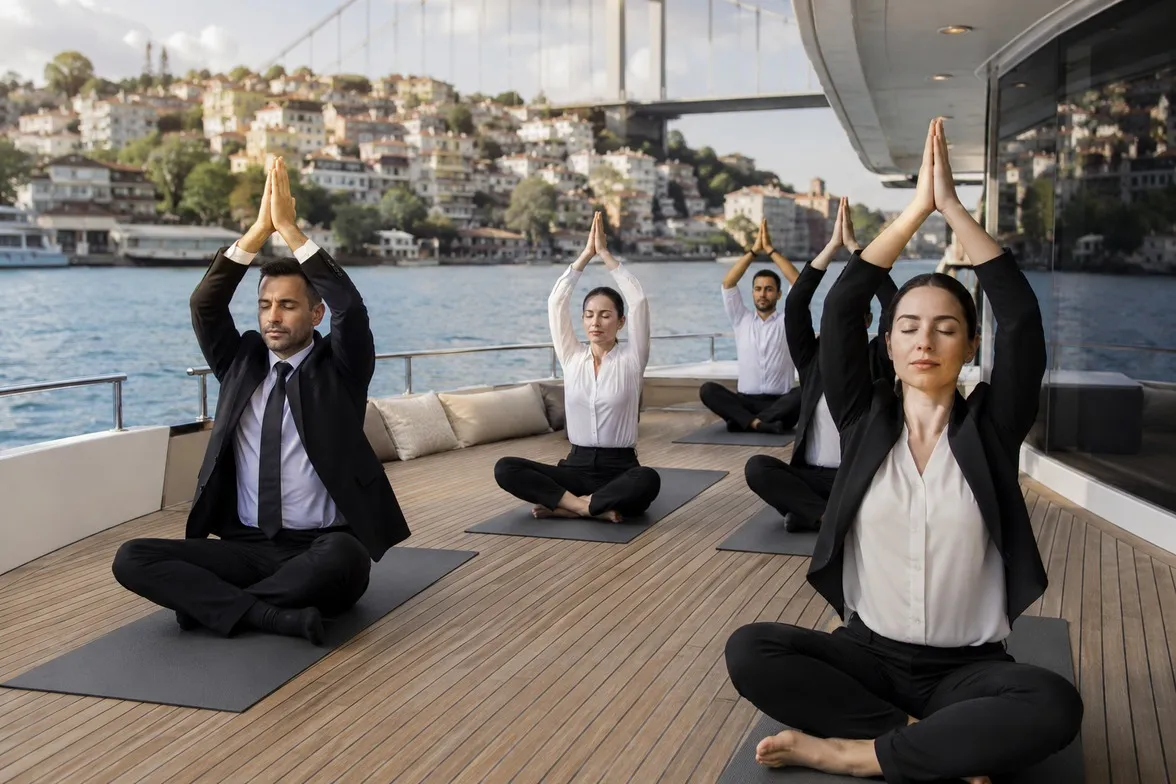
Corporate Yoga on a Boat on the Bosphorus
Corporate yoga on a boat against the unmatched backdrop of the Bosphorus. Balance, breath and team c...
About Sailing
Sailing is the corporate event format that shows team behaviour most directly. A boat forces everyone to do a different job at the same time, and those jobs have to connect within seconds: one person steers, one reads the wind, two pull lines, one watches the boat ahead. A correct action performed in the wrong order achieves nothing. That is why sailing is one of the few settings where "working together" is actually tested rather than discussed.
Types of corporate sailing programmes
Requests for corporate sailing fall into three formats. Which one is right depends on whether the team has been on the water before and what outcome the event is meant to produce.
- Sailing training: The goal is skill. Theory ashore, practice on the boat. By the end of the day participants can perform basic manoeuvres. Spread over two days, retention improves markedly.
- Mini sailing skills race: The goal is friendly competition and team identity. Not an official regatta — an instructor-led mini sailing skills race. Departments are split across boats, every sailboat has an instructor on board, and teams compete on a short course in manoeuvres, tacks, sail trim and helming tasks with simple scoring. No participant experience is required; the instructor is responsible for the safety of the boat while the team executes the manoeuvres.
- Sailing experience / blue cruise: The goal is socialising and reward. No competition and no curriculum — just sailing, a bay stop, swimming and lunch on deck. This is the easiest format to run with mixed-seniority groups and a wide range of participants.
Roles on a boat and their equivalents at work
Sailing is chosen for corporate programmes for structural rather than metaphorical reasons. The roles on a boat map almost one-to-one onto the roles in a team, and the cost of role confusion is visible immediately.
- Helm: Owns the course. Takes information from others, makes the decision alone.
- Trimmer: Continuously adjusts the sail to the wind. The role of small, constant improvement.
- Pit / cockpit: Manages the order in which lines are released and taken up. The coordination role.
- Bow: Carries information from the front to the back. If what they see is not reported clearly and in time, the manoeuvre breaks down.
- Tactician: Reads wind shifts and the position of other boats, and proposes the next move.
In a tack, these five roles engage in sequence within roughly four seconds. Break the sequence and the boat stops. Participants learn this by doing rather than by being told, which is why the post-event debriefing session works.
Season and location
On the Turkish coast the corporate sailing season generally opens in early April and closes at the end of October. Each region has a different wind character, and this directly affects the choice of programme.
| Region | Character | Suitable format | Best window |
|---|---|---|---|
| Çeşme / Alaçatı | Northerly meltemi building through the afternoon, consistent | Mini sailing skills race, training | May–September |
| Bodrum / Gökova | Sheltered gulf, moderate wind | Experience, blue cruise, training | April–October |
| Göcek / Fethiye | Many enclosed bays, calm water | Experience, overnight programmes | April–October |
| Istanbul Bosphorus / Marmara | Current and heavy marine traffic | Half-day experience, short training | May–October |
Çeşme's steadily building afternoon breeze offers the most predictable conditions in Turkey for a mini sailing skills race. Gökova and Göcek suit teams going to sea for the first time and programmes that prioritise comfort for mixed age groups.
Participation requirements
No sailing experience is needed; most programmes are designed for complete beginners. The points that matter:
- Being able to swim is not mandatory, but it must be declared. Life jackets are standard on board, and every sailboat has an instructor.
- Mobility limitations, back or knee problems, pregnancy and heart conditions should be reported in advance; a calmer boat or a sheltered route is usually arranged for these participants.
- Seasickness is common and largely preventable. Medication is taken about an hour before departure; staying on deck and looking at the horizon helps.
- Non-slip shoes, a windbreaker, a sunglasses retainer and high-factor sunscreen are the four items that make the most practical difference.
Group size and boat planning
In sailing, headcount translates directly into logistics. Total group size is planned between 4 and 150 people; a small team of 4 can do training or a boat day on a single boat. Active participation requires enough working space per person, so as the group grows the number of boats grows; packing people onto one boat lowers the quality of the programme.
- In a training format, 5–8 participants per boat is the upper limit if everyone is to take the helm and handle lines.
- In a mini sailing skills race, 6–10 participants per boat is typical; four or more boats create a genuine competitive feel.
- Above 60 people, sailing is usually run in rotation with a second activity ashore rather than on its own.
How pricing works
A fixed list price is not realistic for corporate sailing, because most of the cost is built on a per-boat, per-day basis. The quote is driven by:
- Number and class of boats
- Programme length (half day, full day, two days, overnight)
- Number of instructors
- Location and season (July–August differs markedly from May–June)
- Extras: transfers, accommodation, catering, photo and video, award ceremony, branding
The first step is therefore usually sharing a budget range and headcount, after which the programme is built around them.
When sailing is not the right choice
The honest answer is that it does not suit every team. If headcount is high and the budget will not cover the required number of boats, the experience is diluted and the event misses its purpose. If anxiety about the sea is widespread, pushing it backfires. If the date falls in winter, it is out of season. In those cases rowing, kayaking or indoor team programmes produce better results; the right recommendation is to fit the activity to the team, not to sell the event.
For a detailed read on the mini sailing skills race format
This page frames corporate sailing across all its formats. The mini sailing skills race itself — course, crew roles, scoring and the flow of the day — is described step by step in the sailing experience guide for companies; sharing it with your team before asking for a quote speeds up the format decision.
Frequently asked questions
Does the team need sailing experience for a corporate sailing event?
No. Most corporate sailing programmes are designed for teams that have never been to sea. Every sailboat has an instructor on board who is responsible for its safety; participants handle lines, sail trim and the helm under their direction. After a half-day briefing and practice, an inexperienced team can take part in basic manoeuvres.
When does the corporate sailing season start and end?
On the Turkish coast the season generally opens in early April and closes at the end of October. On the Aegean coast, May–June and September–October offer the best combination of wind and temperature. July–August is possible but costs more due to heat and marina congestion. November–March is out of season for corporate sailing.
How many people can be on one boat?
To keep participation active, we recommend 5–8 people per boat for training and 6–10 for a mini sailing skills race. Total group size is planned between 4 and 150 people; a team of 4 can do training or a boat day on a single boat. A group of 30 is typically spread across 4–5 boats and a group of 60 across 8–10. Putting more people on a boat lowers the cost but noticeably weakens the experience, because time on task per participant drops.
Can an employee who cannot swim take part?
Yes. Life jackets are standard on board and the programme does not require entering the water. However, non-swimmers must be declared at registration; this is taken into account in boat allocation and the briefing.
What is done about seasickness?
Seasickness is common and largely preventable. Taking medication about an hour before departure, staying on deck rather than in the cabin, looking at the horizon and not sailing on an empty stomach are the most effective measures. For sensitive participants, more stable boats sailing in sheltered bays can be arranged.
How long does a corporate sailing event take?
There are three common formats: half day (3–4 hours, introduction and a short sail), full day (6–8 hours, the standard for training or a mini sailing skills race) and a two-day programme (where skill retention improves markedly). The overnight blue cruise format runs 2–4 days.
What happens if the weather is bad?
Sailing depends on conditions; on the morning of the sail, at a decision time agreed in advance, the instructor assesses wind and weather and makes the call. If wind is above the safe limit or a storm warning is in place, the programme is postponed or moved to a sheltered route. We therefore recommend defining a backup date and a land-based backup in the contract from the start.
How are corporate sailing prices determined?
A fixed list price is not realistic because most of the cost is built per boat, per day. The quote is driven by the number and class of boats, programme length, number of instructors, location, season and extras such as transfers, accommodation, catering, photo and video and an award ceremony. Headcount, date range and a budget band are enough for a firm quote.
Should we choose sailing training or a mini sailing skills race?
It depends on the outcome you want. For skills and shared learning, choose the training format; for friendly inter-department competition, team identity and a day that ends with an award ceremony, choose an instructor-led mini sailing skills race; for socialising and reward, choose the experience or blue cruise format. For mixed-seniority groups and first-time events, the experience format is the safer start.
When is sailing not the right choice?
If headcount is high and the budget will not cover enough boats, if anxiety about the sea is widespread in the team, or if the date falls between November and March, sailing is not the right tool. Rowing, kayaking or indoor team programmes work better in those cases.