
Esports Services
Corporate esports: inter-company leagues, in-house squads, FIFA tournaments, racing simulation and VR stations. The one format that puts teams in different cities in the same fixture.
Last updated:
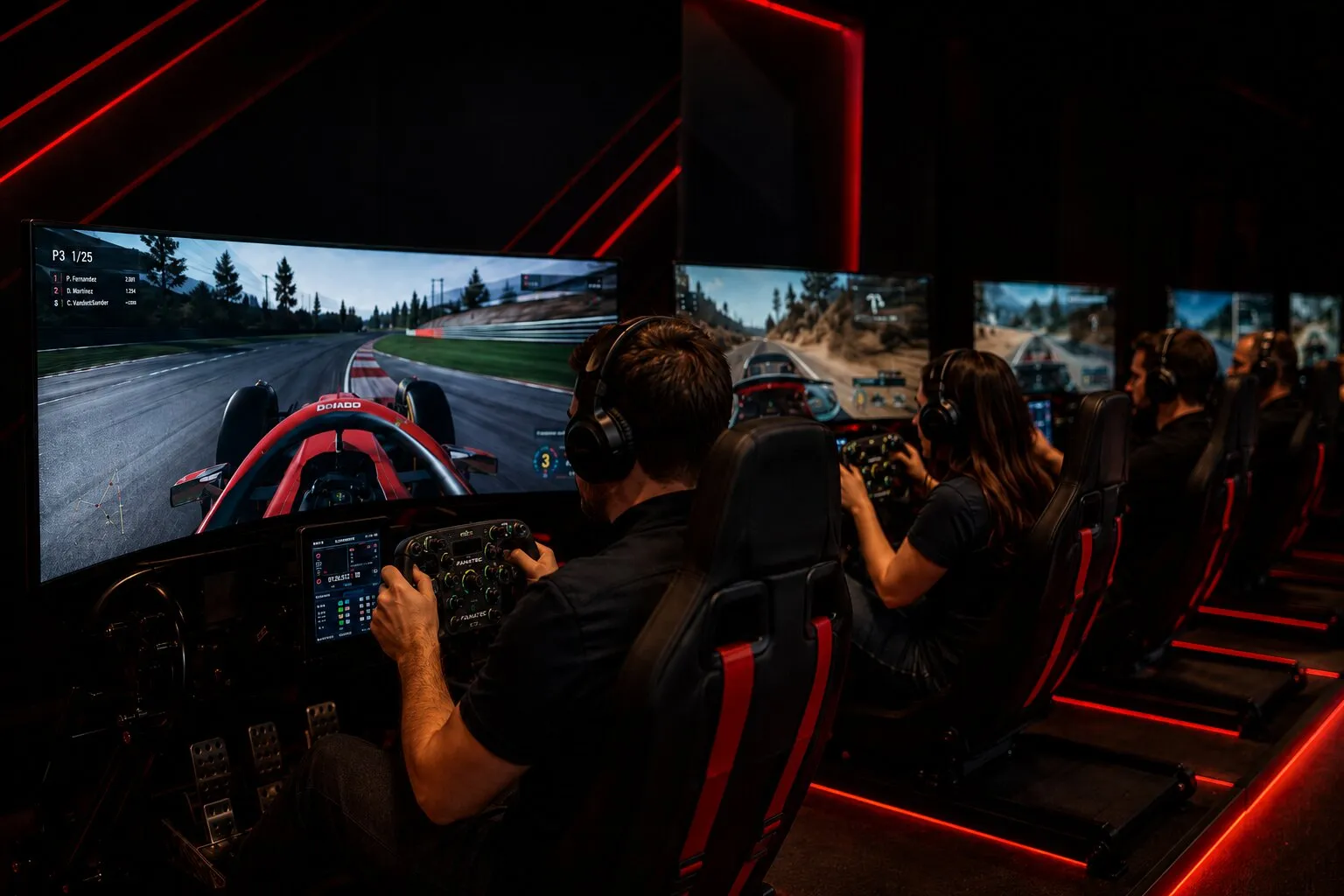
F1 & Rally Simulator Corporate Racing Experience
A corporate F1 and rally experience on professional simulators. High competition, team strategy and...

Sailing Experience and Dinner
Crew a sailing yacht in teams by day, then gather around the same table in the evening. A meal-inclu...

VR Combat Game Experience Booth
A team-based VR combat game station built around reflexes and tactics, installed at your venue. Oper...

In-House FIFA Tournament
A fixtured in-house FIFA (EA FC) tournament run on console stations installed at your office or venu...

Year-End Corporate Events
A December programme: an awards ceremony, a look back at the year, and a closing event combined with...

Corporate Esports League
An esports league bringing office, remote and hybrid teams into the same fixture: tournament platfor...

Corporate Ultimate Frisbee Team
Build an ultimate frisbee team: self-refereed play, mixed squads as standard, non-contact, and the l...

Corporate Esports Team
Set up a company esports team: game selection, remote training structure, role allocation and prepar...
Corporate VR Experience Event
Virtual reality stations installed at your office: multiplayer missions, no physical barrier to entr...

Corporate Flight Simulator Experience
Flying in a real cockpit layout: a take-off and landing attempt with an instructor, indoors and inde...
About Esports
Esports earns its place in a corporate programme by solving a problem no other sport can: geography. Teams in different cities, different offices and working from home meet in the same fixture, at the same time and on equal terms. Physical fitness, age and mobility present no barrier, which brings in a group of employees that pitch sports never reach.
The only format on this site that crosses borders
This is the distinction worth reading first. Every league we run needs players who live in the same city — except this one. A squad drawn from your Istanbul office, a European hub and a Gulf office can play the same fixture on the same evening, with no travel budget attached. The time zones across those markets are close enough for a shared evening slot to work, which is not true of a league spanning Asia and the Americas.
For a regional team whose engagement programme is otherwise a set of separate local activities, this is the piece that makes the Turkish site visible to the wider organisation rather than running in parallel to it.
Formats
- Inter-company league. A fixture across weeks, league table, referees and an anti-cheat rule set, with a commentated broadcast for the final week.
- Building an in-house squad. Game selection, role allocation, weekly practice and post-match review. Role ambiguity is the most common reason corporate squads fall apart.
- One-day tournament. An in-house FIFA tournament is the most common version; it needs no rules knowledge and everyone can play on day one — which makes it the format a visiting group can enter.
- Simulation and stations. Racing simulators and VR stations installed at an office or event venue, reaching hundreds of people through rotation.
Game selection sets the character
Team-based titles in five-a-side formats create a real league feeling — role allocation, strategy, communication — but carry a high learning barrier and exclude colleagues who have not played before. Sports and racing titles bring people in at almost zero barrier with a weaker team dynamic. For most companies the right answer is both: a competitive core league and a wide open lane.
Colleagues who do not play
This is the real risk on the corporate side: the programme becoming confined to a subgroup. Two measures reduce it — an open lane on a low-barrier title, and a broadcast event where the final week is watched together in the office. The second is what decides whether the programme survives into a second year.
A framework written down first
Three things are settled before the league starts: that the activity is voluntary and outside working hours, the age ratings and content suitability of the chosen titles, and alignment with IT policy where company hardware is involved. The anti-cheat rule set is shared at the same time. Where your organisation operates under a group-wide code of conduct, this document is what lets a local programme be approved without a case-by-case escalation.
In-house esports: a tournament built at the office
What most companies searching for an "in-house esports tournament" want is not a league but a one-day format built at the office. No venue is needed: four to eight gaming stations (console or PC, monitor, headset) go into a meeting room, the screen is projected and a two-to-four-hour tournament flows from lunch to the end of the day. The lowest-threshold title is football simulation (EA FC): everyone knows the rules, a match is ten minutes, a crowd forms. Racing and party games are added as a second station. Our difference is not bringing the equipment but the combination of moderator, fixtures and physical sport: with a table tennis or darts station set up the same day, employees who do not play games stay inside the programme. That combination is what pure esports platforms do not offer — and for a visiting team it is the one format that needs no daylight, no season and no kit.
Frequently asked questions
Which games are played?
The choice follows the company's employee profile. Football and racing titles give the widest participation because they need no rules knowledge. Team-based titles produce a more competitive league but narrow the player pool. Age ratings and licence conditions are checked during setup.
Can fully remote teams take part?
Yes, and this is esports' greatest strength on the corporate side. Matches are played in online lobbies and results verified through the platform. In a hybrid setup some teams connect from the office and others from home. Connection quality is the only technical requirement and is tested beforehand.
Will colleagues who do not play feel excluded?
It is a genuine risk and it is reduced by the design: an open lane on a low-barrier title, and a broadcast event where the final week is watched together in the office. The second brings non-playing colleagues into the organisation too.
Is it played during working hours?
The standard setup is outside working hours and voluntary. Some companies run lunchtime or after-work sessions in the office; in that case it is stated clearly that participation is voluntary and not connected to performance evaluation. The framework is shared in writing before the league starts.
How are cheating and account sharing prevented?
The rule set is shared in writing at the start: account sharing and substitute players are prohibited, screen sharing may be requested, and a dispute process is defined. Deterrence is usually sufficient because participants know each other from work.
Does the company provide hardware?
For remote participation, players use their own. If an esports corner or a final-day setup is wanted at the office, console or PC, screens and seating are included in the organisation; that raises the visibility of the programme and lifts participation with it.
Are simulators and VR stations part of this?
Yes. Racing simulators and VR stations are installed at an office or event venue and run on rotation. They differ from the league format: they produce an experience rather than a competition, and they suit trade fairs, launches and family days where the flow of people is irregular.
Does it replace the pitch leagues?
It should not. An esports league produces the most value set up alongside them: it opens a second door for employees who cannot join a football or basketball league and raises the overall participation rate. Two leagues can run in parallel in the same season.