
HR-Oriented Programs
HR-oriented programmes are training formats that develop skills such as communication, leadership, teamwork, stress management and problem solving through sport- and movement-based exercises. They are designed around your HR objectives and can be added to your internal training calendar.
Last updated:

Communication Skills Development
An experiential programme that works communication under pressure: coordinating on limited informati...

Senior Leadership Programme
A small-group field programme for managers on decision-making under uncertainty, delegation and prio...

Using Your Counterpart's Force: A Negotiation Workshop
A workshop carrying aikido and judo principles to the negotiating table: redirecting incoming pressu...

Teamwork and Coordination
A programme working role clarity and handover points: tasks requiring synchronisation that make visi...

Stress Management and Motivation
Bringing the arousal regulation techniques athletes use into the office: breathing protocols, recove...

Problem Solving and Decision Making
Structured decision work under time pressure: making measurable the balance between gathering inform...

Time Management and Productivity
A programme that works limiting concurrent workload: pit-stop and station setups that measure the co...

Customer Relations and Sales
Discovery questions, handling objections and difficult conversation rehearsals: a practical workshop...

Archery Leadership Programme: Focus, Decisions and Feedback for Managers
An archery leadership workshop for managers: facilitated shooting rounds, coach–archer pairs and str...
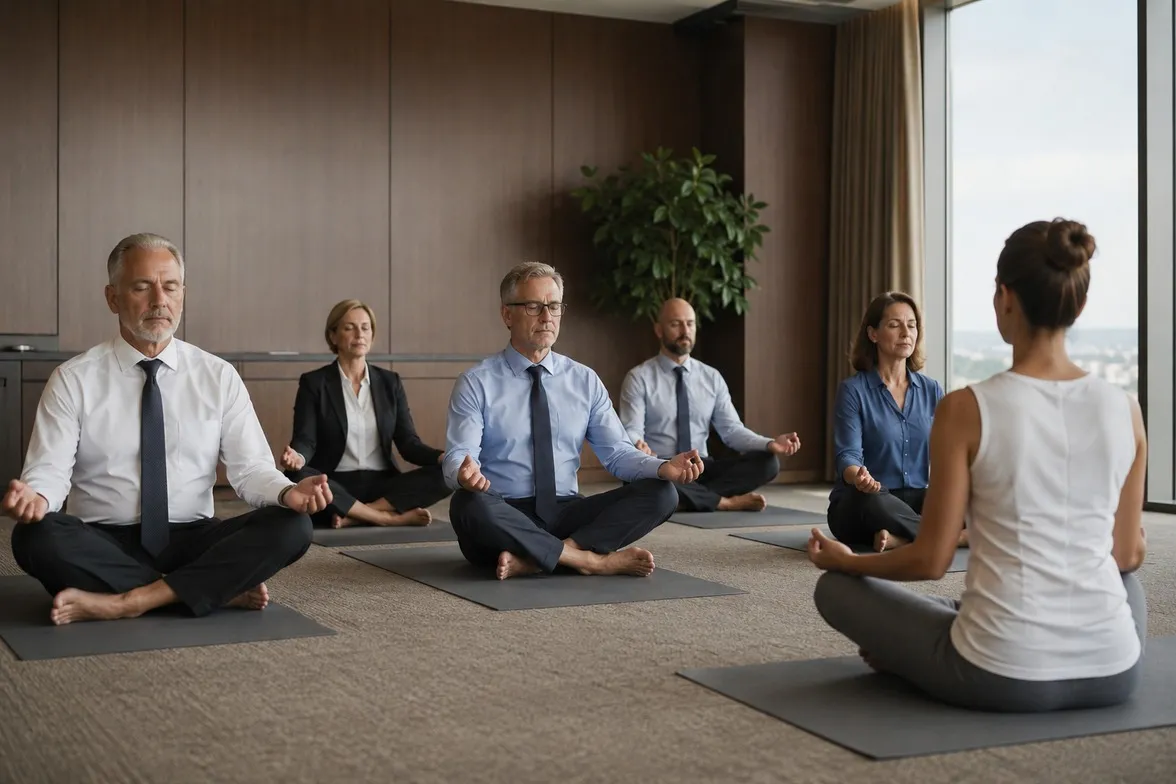
Yoga and Stress Management for Senior Leaders
Yoga and stress management designed for senior leadership. A programme that improves decision qualit...
About HR-Oriented Programs
Development sessions that fit an offsite
These are experiential programmes: the group works through tasks that produce an undeniable result, then examines what happened. They exist because behaviour does not change by listening to a presentation — people do not remember accurately how they behaved in a meeting, and "I said it clearly" versus "that is not how I understood it" can only be resolved when something visibly goes wrong.
For a visiting team this is the part of the trip that justifies the travel budget internally. A leadership offsite in Turkey that includes two structured development blocks reads very differently in an approval email than a trip that is only activities.
Available programmes
- Communication under pressure. Restricted-information tasks, feedback rehearsal, review of recordings.
- Senior leadership. Decisions with incomplete information, delegation, crisis prioritisation, rotating leadership so every participant leads at least once.
- Teamwork and coordination. Mapping handover points and measuring how much time is lost at each one.
- Problem solving and decision making. Information budgets, assumption testing, decision journals.
- Negotiation — redirecting force. An aikido principle applied to objection handling; the physical part takes minutes, the application takes the rest of the session.
How it fits a trip
The usual structure places a development block in the morning, when attention is highest, and an activity in the afternoon. Over two or three days this alternation holds a group's energy far better than consecutive meeting-room sessions. Your own content and agenda stay yours; we run the experiential blocks and the venue coordination.
What these programmes are not
They do not produce input for performance reviews and should not be used that way — participants only behave openly when they know observations will not reach HR files. Reports to the company cover group-level patterns, never individuals. They are also not a substitute for structural fixes: if a team's problem is workload or unclear ownership, a workshop will mask it rather than solve it, and we will say so.
Frequently asked questions
Are these delivered in English?
Yes for international groups, including the debrief discussions where most of the value sits. Facilitation quality in the debrief matters more than in the tasks, so this is confirmed specifically at booking.
Can this be combined with our own agenda?
That is the normal arrangement. Your sessions and content stay with you; we run the experiential blocks and coordinate venue and timings. The usual structure is a working block in the morning and an experiential or activity block in the afternoon.
Will we get a report on individuals?
No. Reports cover group-level patterns only. Participants are told at the opening that observations will not be shared individually or reach HR files — without that, people manage their behaviour and the session produces nothing useful.
How large can the group be?
Four to thirty for leadership programmes, eight to fifty for the others. These limits come from how the format works rather than logistics: above them, discussion turns into presentation and not everyone gets a turn in the leading role.
Do you cover negotiation training?
Yes — one programme adapts an aikido principle to objection handling: meeting incoming force with force loses balance, redirecting it keeps control. Participants feel it physically in a few minutes, then apply it to their own real objections for the rest of the session.