
Company Sports Club: How to Set Up a Corporate Sports Club and Company Teams
A football team, a running club, volleyball, tennis, sailing or a yoga group: we bring your company’s regular sports groups together in one club structure and run it from set-up to season planning.
A company sports club is a permanent structure that brings the teams and groups in which employees play sport regularly under one roof. It differs from a one-off event because it continues, and from a single team because it covers several sports and different levels. We set up the teams, organise coaches and instructors, venues, kit and league entry, and plan the club’s season calendar with you.
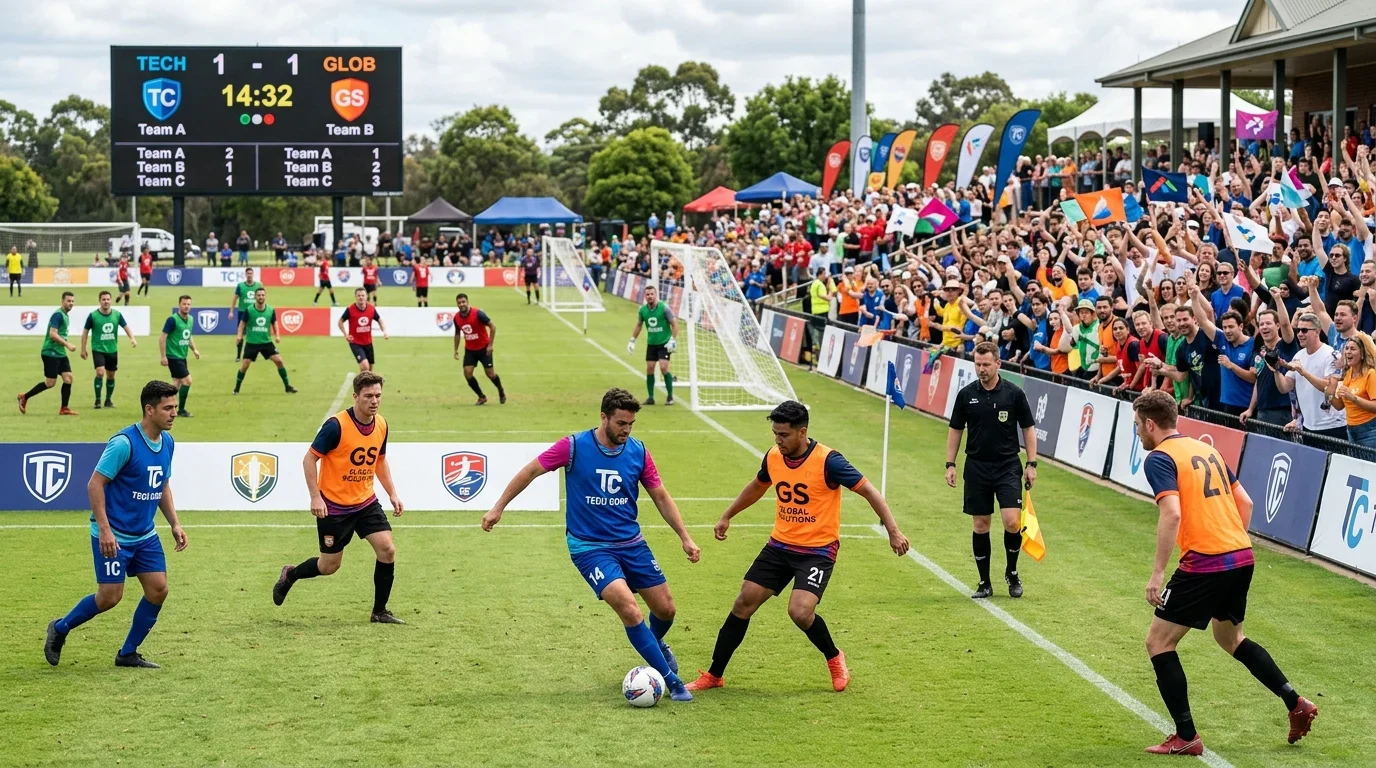
A company sports club is a permanent structure that brings the teams and groups in which employees play sport regularly under one roof. It differs from a one-off event because it continues, and from a single team because it covers several sports and different levels. We set up the teams, organise coaches and instructors, venues, kit and league entry, and plan the club’s season calendar with you.
Last updated:
What is a company sports club and how do you set one up?
Short answer: A company sports club is a permanent structure that brings a company’s employee teams and regular sports groups (for example a football team, a running club, volleyball, tennis, sailing, or a yoga or Pilates group) under a single management, budget and calendar. To set one up, you gauge interest, start with one or two sports, appoint a club lead and build a season calendar with fixed days and times. As the club grows, new sports and inter-company league entry are added.
In many companies sport already happens: a group that plays five-a-side on Wednesday evenings, a few people who run in the morning, a team doing yoga at lunchtime. A club is the framework that makes these scattered groups visible, budgeted and sustainable.
Club, event, league and team: how they differ
| Structure | Duration | Scope | When is it right? |
|---|---|---|---|
| One-off sports event | A full or half day | The whole team, one programme | For a single moment such as a get-together, year-end or kick-off |
| Inter-company league or internal tournament | A fixture list of several weeks | One sport, a set number of teams | For competition and a shared agenda over a defined period |
| A single company team | Season-long | One sport, a fixed squad | When one sport has strong interest and the company wants to be represented |
| Company sports club | Open-ended, run in seasons | Several sports, different levels, competitive and non-competitive groups | To turn sport from a single event into a lasting employee benefit |
Which club model suits you?
| Choice | Option A | Option B | How to decide |
|---|---|---|---|
| Number of sports | Single-sport club: e.g. only a football team or a company running club | Multi-sport club: team sports, racket sports and wellness groups together | Headcount and spread of interest; one sport starts faster, several reach a wider audience |
| Management | Employee-led: volunteer captains, the company only provides the budget | Organiser-supported: coaching, venues, calendar and logistics run externally | How much time volunteers can give; clubs fall apart when the load rests on one person |
| Competition | In-house: department teams, internal tournaments | Inter-company: representing the company in external leagues and tournaments | Whether the goal is internal bonding or external visibility and employer brand; most clubs do both |
How to set up a company sports club, step by step
- Gauge interest: A short survey collects which sports people want, how many, their levels and suitable days and times.
- Choose the starting sports: Start with the one or two sports that draw the most interest. For inclusion, a team sport plus a low-threshold group (running, volleyball or yoga) is a good pairing.
- Club lead and captains: Appoint a club lead from inside the company and a captain or group leader for each sport.
- Budget and rules: Put in writing what the company covers, the participation rules and how people sign up.
- Venues, coaches and a fixed calendar: Book a fixed day, time and venue for each sport and assign a coach or instructor.
- Club identity: Create a club name, kit and a shared communication channel.
- A goal for the season: Put something in the calendar that gives the season meaning: an internal tournament, friendly matches, an inter-company league or a target run.
Running the club: six essentials
- Club lead: Without someone tracking attendance and communication, a club rarely reaches its second season.
- Budget: Agree up front which of venue, coaching, kit and league fees the company pays and which members pay.
- Participation rules: Who can join, how to sign up, how match squads are picked; written down and the same for everyone.
- Season calendar: Training days, holiday breaks, internal tournaments and league matches in one calendar.
- Kit and identity: A shared club name and kit bring members from different sports together as one community.
- Communication channel: One group channel for announcements, squad call-ups and short weekly updates.
How do you keep participation alive?
Clubs are usually set up with enthusiasm in the first months and then erode through workload and travel. Three things prevent this: level groups (runners and run–walkers, A and B tiers), a fixed day and time (a shifting calendar lowers attendance) and inclusive sports (not everyone plays football; volleyball, running or a weekly office yoga hour cover different profiles). Keeping the squad larger than you need also matters: a pool of around 16 for five-a-side means no week gets cancelled. If the club is part of a wider wellbeing strategy, see our corporate wellness programmes as well.
What setting up a company sports club includes
Interest survey and sports plan
An employee survey, the spread of interest and levels; which sport to start with and in what order the club will grow.
Squad set-up
A taster or trial session, level assessment and a squad plan with reserves. The aim is not to cut people but to see the spread of levels and positions.
Coaches and instructors
A coach or instructor for each sport; technical development, match preparation and a warm-up and injury-prevention routine.
Venues and a fixed calendar
A fixed weekly day and time at a pitch, indoor hall, court or marina, and a season calendar.
Kit and equipment
Company-branded kit and sport-specific equipment, carrying the club name and identity.
League and tournament entry
Entry to inter-company leagues, friendly matches and internal tournaments: concrete goals for the season.
Club management support
Participation rules, sign-up process, budget lines and a communication channel template for the club lead.
Wellness groups
Weekly yoga, Pilates or running groups for employees who do not want to compete: the inclusive side of the club.
How the quote takes shape
The cost of a company sports club depends on the number of sports, the number of members, training frequency and the venue, which is why there are no prices on this page. The quote is settled in three steps.
Interest and sports
An estimated membership, the sports people are interested in, their levels and your city and district set the starting sports and the club model.
Calendar and venues
Training frequency, a fixed day and time and venue options for each sport; the season start, holiday breaks and target leagues or tournaments.
Scope and quote
Coaching, venue, kit, equipment and league entry lines are chosen one by one; the quote shows fixed and per-member lines separately and arrives within 24 hours in TRY, USD or EUR.
What drives the budget
When comparing club budgets, check that each of these lines is itemised. Instead of figures, we show what changes the cost and why; our quote lists the same lines one by one.
| Line | What it covers | Effect on the budget |
|---|---|---|
| Number of sports | How many separate teams or groups the club runs. | Each sport means its own venue, coach and equipment; starting with one sport and growing keeps the first-season budget in check. |
| Members and participants | Squad size, level groups and the reserve pool. | Sets the number of groups and kit items; more level groups mean more sessions and instructors. |
| Training frequency and season length | One or two sessions a week; a season or all year. | The main multiplier behind total venue and coaching hours. |
| Venue and pitch | Five-a-side pitch, indoor hall, court, marina or space in the office. | Varies by sport, city and time slot; evenings are the busiest. Yoga and Pilates held in the office reduce this line. |
| Coaches and instructors | Technical development, match preparation and safe training. | Depends on the sport and number of sessions; some groups (e.g. running) can be supported by volunteer group leaders. |
| Kit and equipment | Club kit, sport-specific equipment, printing. | Varies with quantity and printing method; made once and used for several seasons, with extra items planned for new members. |
| League and tournament entry | Inter-company league registration, tournaments and friendlies. | Entry fees, transport and, if needed, accommodation; which leagues to enter is chosen at the start of the season. |
| Communication and club identity | Club name, logo, announcement visuals, photo and video. | Usually a small line with a large effect on attendance; can be run together with your internal comms team. |
Which lines the company covers and which members cover is set in the club rules. Quotes can be issued in TRY, USD or EUR.
Which sports can the club include?
Depending on employees’ interests and levels, a club can combine team sports, racket sports, water sports and wellness groups. The programmes below can be set up as the club’s teams, individually or together.

Set up a company football team at your Turkey site: open trials, squad-depth planning, a weekly training slot,...

Build a company volleyball team in Turkey: mixed squads by default, rotation coaching, serve and bump fundamen...

Build a company basketball team in Turkey: a ten-player squad, level balancing, indoor training and preparatio...

A standing squad representing the company externally: selection, weekly training, squad management and a compe...

A company sailing team made up of your employees: regular instructor-led training sessions, periodic mini sail...

Setting Up a Company Running Club
A running club built on continuity rather than a target race: a fixed weekly meeting, level groups and a club...

Boost employees mind-body balance and focus with a weekly office yoga session.

Core strengthening and posture correction with a weekly pilates package.

Corporate Five-a-Side Football League
An inter-company five-a-side league: seven-a-side format, a fixed evening slot, with referee and fixture manag...
Frequently Asked Questions
How many people do you need to start a company sports club?
Which sports should we start with?
Is the club run by employees or by an external organiser?
What does the budget depend on?
Can club teams enter inter-company leagues?
How do we keep newcomers in the club?
How can hybrid teams or staff in other cities take part?
Can the club be run in English?
Read before you decide
Building an Inter-Company Sports League: A Season Planning Guide
An inter-company league is a completely different operation from a one-day tournament. Fixtures, squads, officials, comm...
Join an Existing Company League or Build Your Own?
Entering a team in an open company league versus building a private internal league or an invitation-only inter-company...
How to Raise Attendance at a Corporate Event: 9 Practical Methods
The event is ready, the budget approved, the date set — but nobody signs up. The real reasons attendance drops and what...
10 Effective Corporate Team-Building Sports That Strengthen Team Spirit
10 effective corporate team-building sports that strengthen team spirit: from volleyball to rafting and dragon boat, the...
Get a tailored proposal within 24 hours
Share your headcount and approximate date; we will come back with the format and budget range that fit, within the same business day.
Get a Free Quote