
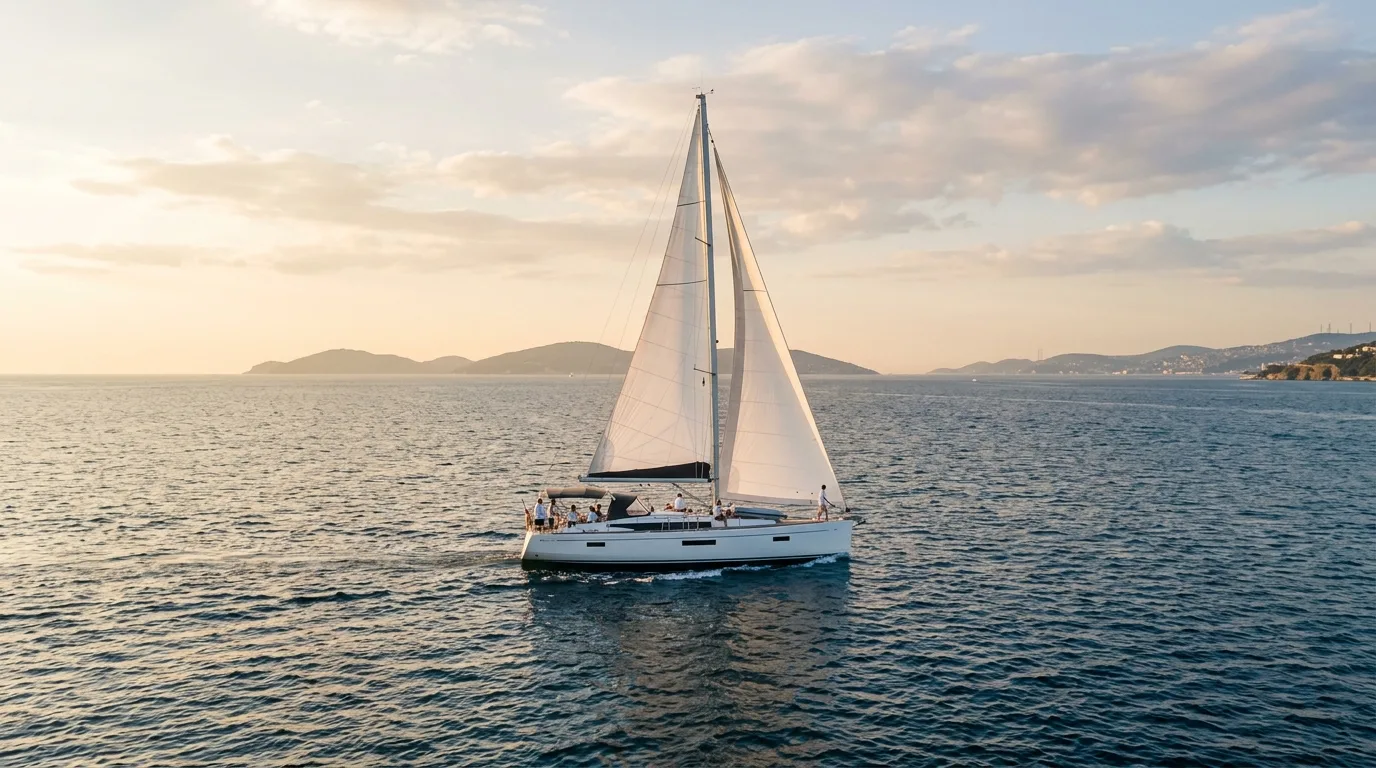
Plan a company sailing day step by step: choosing the format, marina and season, boat maths, crews and roles, the day’s flow, a weather plan, an instructor-led mini sailing skills race and the prize-giving.
A company sailing day is a half-day team event in which employees are split into small crews, each on a yacht with an instructor on board, and after a short practice session the crews compete on a short course in manoeuvres, tacks, sail trim and helming tasks. Not an official regatta — an instructor-led mini sailing skills race. Nobody needs to know how to sail. The real work is deciding in advance how many boats you need, which marina and date, what happens if the weather turns, and which mini-race format suits beginners. The eight steps below give HR and event teams the order to work in, from the first planning meeting to the prize-giving.
The short answer: 8 steps
- Choose the goal and the format: boat day, mini sailing skills race or training?
- Set the season, date and marina, and hold a backup date.
- Work out the number of boats from your headcount (6–8 people per boat).
- Build mixed crews and give everyone a role.
- Write the day’s flow: briefing, practice, mini race, ceremony.
- Fix the safety and weather plan, including decision times.
- Pick a beginner-friendly mini-race format and scoring system.
- Plan the close, the prizes and how you will measure the result.
1. Goal and format: boat day, mini skills race or training
Start with what you want the day to achieve. Corporate sailing comes in three formats, and each answers a different question:
- Boat day / sailing experience: no competition, just sailing, a swim stop in a bay and time to talk. It works well as a reward or a social day. If that is what you are after, a sailing adventure is the better starting point.
- Mini sailing skills race (company sailing race): crews on separate boats, each with their instructor, compete in manoeuvre and task legs on a short course. The point is team identity, communication across departments and a story people will share. This guide covers this format.
- Training: the aim is skill, with theory ashore and practice on the water. If you want people to be more hands-on at future events, begin with sailing training.
Once you have chosen the mini skills race, decide whether it stands alone or attaches to a meeting, a launch or a dinner. That choice drives the time of day and the marina.
2. Date, season and marina
On the Turkish coast the corporate sailing season generally runs from early April to the end of October; in Istanbul the most productive window is May to October. A winter date is out of season, and an indoor team activity is the better choice then.
Istanbul has three main options:
- Kalamış and Fenerbahçe marinas: on the Asian side, with a course towards the Princes’ Islands that makes them the best base for multi-boat programmes and the mini skills race.
- The Bosphorus: strong on scenery and prestige, but currents and heavy shipping make it better for short, controlled programmes and smaller groups.
- Ataköy Marina: shortens the journey for offices on the European side and fits a morning meeting followed by an afternoon sail.
If you want to take the event out of the city, there are two alternatives. Çeşme has a steady breeze that builds in the afternoon, which gives predictable conditions for the mini-race format. Bodrum, with its sheltered bays, suits first-timers and mixed-age groups where comfort matters more. Both mean accommodation and travel become part of the programme.
When you pick the date, reserve a backup date at the same time. For anything on the water it is part of the plan, and finding one at the last minute rarely works.
3. Headcount and boat maths
The quality of a sailing day depends on how many people are on each boat. On 38–45 ft racer-cruisers, 6–8 people per boat lets everyone hold an active job. Overloading boats does not save the day; it dilutes it, because anyone who never touches a line is not really part of the event. The whole group can be anywhere from 4 to 150 people; up to 20 boats can sail at once, and every yacht has an instructor on board.
| Participants | Boats (6–8 per boat) | Suggested format |
|---|---|---|
| 4–8 | 1 | Training or a boat day; a mini race needs at least 2 boats |
| 9–16 | 2 | Boat-on-boat mini skills race over several short legs |
| 20–30 | 3–4 | Leg-by-leg mini race on a short course |
| 40–60 | 6–8 | Department cup, champion on total points |
| 80–120 | 10–15 | Boats split into groups that run the legs in turn |
| 120–150 | 16–20 | Two groups plus a final, or a second shore activity on rotation |
Four or more boats give a genuine race feel. Two boats can still run a mini skills race; just add more legs to keep the competition alive.
4. Building crews and assigning roles
Whether you build crews by department or mix them depends on the goal. If you want better communication across teams, put people from different units on each boat. If you want to celebrate department identity, compete by department but balance seniority: two senior managers on one boat can leave everyone else quiet.
Everyone on board needs a job. The instructor on each yacht is responsible for safety and for running the boat; the crew takes on the core roles:
- Helm: steers the course and makes the call using what the crew reports.
- Jib: handles the headsail sheets; timing in a tack sits with this role.
- Mainsail: keeps trimming the main to the wind.
- Tactician: watches wind shifts, rival boats and the distance along the course, and feeds it back to the helm.
On busier boats, jib and main are handled in pairs, and roles rotate between legs so that everyone takes the helm at least once. Companies that want to keep a crew together over a season can look at a corporate sailing team programme.
5. The day’s flow
A half-day company sailing event takes about 3.5 hours. This outline works well for crews who have never sailed:
| Stage | Time | What happens |
|---|---|---|
| Welcome and briefing | 30 min | Welcome at the marina, crews matched to boats, safety and role briefing, life jackets handed out |
| Practice | 45 min | Basic manoeuvres and tacking drills on the water; the instructor assigns roles |
| Mini sailing skills race | 60–90 min | Manoeuvre, tacking, sail-trim and helming legs on a short course |
| Ceremony | 30 min | Results announced at the marina, trophies and medals |
Remember to add travel time from the office to the marina. The programme can also stretch to a full day or finish with dinner.
What to tell participants beforehand
A short note a few days before the event speeds up the morning briefing and avoids surprises. It should cover:
- Meeting time, marina name and how to get there
- What to wear: non-slip shoes, a windproof layer, a strap for sunglasses and high-factor sun cream
- Health declaration: whether they can swim, any mobility limits or tendency to seasickness
- The weather decision time and backup date, and which channel will carry any cancellation or postponement
- That crews and boats will be announced at the marina on the morning
Collecting health declarations in advance lets the instructors plan roles and boat assignments around them.
6. Safety and weather plan
For a day on the water, the safety plan is written before the event and explained at the briefing. The essentials:
- Life jackets: compulsory for everyone on board, with a demonstration at the briefing.
- An instructor on every yacht: every sailing boat has an instructor on board, responsible for safety, running the boat and guiding the crew.
- Safety briefing: before going out, everyone hears how to move around the boat, the limits of each role and how the instructor’s directions work.
- Decision times: the marine forecast is tracked 72, 48 and 24 hours out, and the final decision time is agreed and shared with participants in advance.
- Backup date: if the wind or weather exceeds safe sailing limits, the pre-agreed backup date comes into play.
- Indoor alternative: if the date cannot move, the programme switches to an indoor team simulation.
Writing into the contract which conditions mean cancellation and which mean postponement saves arguments on the day. For the wider framework, see our guide to event risk planning and weather cancellations.
7. Mini-race format and scoring for beginners
For crews who have never sailed, one long race can turn into an afternoon where a single mistake cannot be undone. A beginner-friendly, instructor-led mini skills race rests on a few principles:
- A short course: close enough that boats can see each other, which keeps it exciting and easy to follow.
- Several short legs: manoeuvres, tacks, sail trim and helming are run as separate legs. A crew that fumbles the first leg can recover in the second, so the result does not hinge on one bad moment.
- Matched boats: use the same class of boat where possible, so the result reflects how well the crew works together.
- Simple scoring: points by position in each leg, lowest total wins. The rules should fit on one page at the briefing.
- A fair-play award: a separate prize for the crew with the best team spirit keeps the boats at the back motivated too.
In practice: picture six boats in a mini skills race with three short legs. The winner of each leg scores 1 point, second scores 2, and so on. After three legs the boat with the lowest total is champion, with ties broken by the last leg. Announcing the standings after each leg keeps the boats at the back in the game until the end.
8. Close, prizes and measurement
The ceremony is the part people remember. Results are announced at the marina, trophies and medals are presented, and the fair-play award goes out on the same stage. Photos from the boats and a short recap give internal communications ready-made material.
It also pays to mark the standout moments, not just the winners: the cleanest tack, the best-trimmed sails, the first-timer who took the helm and turned the boat on the course. Those small moments become the story people tell in the office the next day.
To find out whether the day worked, run a short survey within a few days: how involved people felt, who they met for the first time, where communication broke down on board, and ideas for next time. Specific moments from the mini race become lasting lessons when a debrief links them back to how work flows in the office.
Can a team that has never sailed do a sailing day?
Yes. Corporate sailing events are largely designed for crews starting from zero. The instructor on each yacht is responsible for safety and for running the boat, and the crew carries out the manoeuvres learned in the briefing and practice under the instructor’s direction. There are limits worth knowing, though:
- Wind limits: in very light air the programme slows down, and above safe limits the boats do not go out. That is why a weather plan and a backup date are essential.
- Seasickness: common and usually preventable. Medication is taken about an hour before sailing; looking at the horizon and staying on deck help.
- Limited mobility: back or knee problems, pregnancy or heart conditions should be declared in advance. These participants can take less physical roles such as tactician, or a calmer boat can be arranged.
- Swimming: not required, but it should be declared.
If serious anxiety about the sea is widespread in the team, choosing a different format will work better than pushing sailing.
To speed up your planning
If you would rather have one team handle the operational side of these steps (marina, fleet, instructors, safety briefing, the mini skills race, ceremony), our corporate sailing page sets out the formats and scope. Share your date range, approximate headcount and preferred marina, and the Kurumsal Sporlar team, licensed under TÜRSAB A-12558, will put together a programme for you: request a proposal.

Leave a Comment