
SUP (Stand Up Paddle) Services
Corporate SUP (stand-up paddle) in Turkey: standing paddle on still water; balance, an individual challenge and a low equipment threshold. No swimming required, buoyancy aids mandatory; lakes and sheltered bays, 6–40 people, run in English.
Last updated:

Rowing Instruction Programme
Applied rowing instruction that moves from the ergometer to the water: stroke technique, synchronisa...

Corporate Paddling Adventure
A route, not a lesson: dragon boat or canoe along a sheltered bay or lake course, where the aim is t...

Corporate Rowing Team
Build a standing company rowing crew in Turkey: boat class selection, synchronisation training, cox...

Sapanca Lake Corporate Canoe and Paddling Experience
Flat water 90 minutes from Istanbul: no waves, two-person canoes, and a format that returns the same...

Mogan Pedal Boat Company Package
Mogan Pedal Boat Company Package corporate organization. Professional team, end-to-end service.
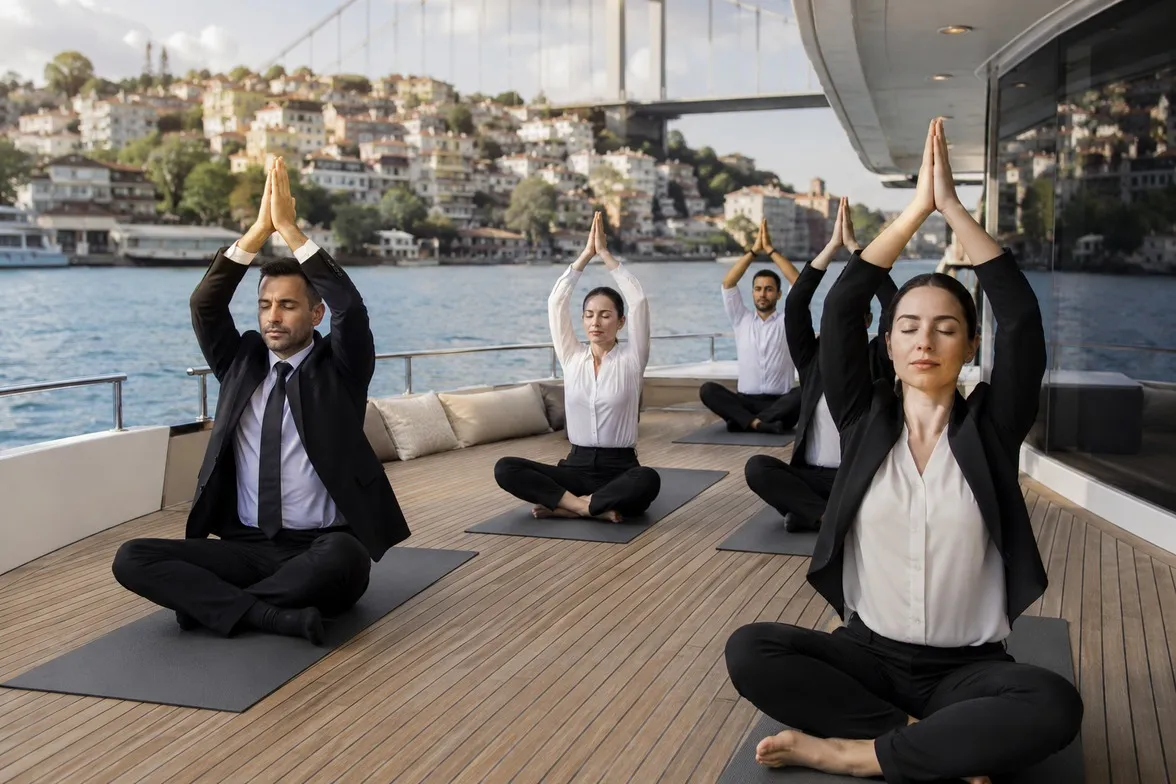
Corporate Yoga on a Boat on the Bosphorus
Corporate yoga on a boat against the unmatched backdrop of the Bosphorus. Balance, breath and team c...
About SUP (Stand Up Paddle)
SUP (stand-up paddle) is the newest and most individual of the water sports: one board, one paddle, one person. What separates it from canoeing and rowing is that the event is built not on team synchrony but on personal balance. The first ten minutes are spent kneeling, the next ten standing and shaking, and after half an hour paddling comfortably. That curve is the same for everyone, and it is the real value of the event: everyone overcomes the same fear at the same time — and it needs no shared language.
Why a team does SUP
Most corporate events are team-centred; SUP delivers an individual challenge inside a group. Nobody carries anybody, nobody can balance for someone else — but everyone sees each other fall and get up. That builds a different language, especially for teams tired of "team game" formats or those that value individual achievement (sales, consulting, technical specialists). In wellness programmes SUP combines with yoga: a 20-minute balance and breathing session on the board.
The half-day flow
- Briefing (15 min). Buoyancy aid, board and paddle, falling and getting back on. Falling is normal and is practised deliberately in the briefing.
- Kneeling start (15 min). Paddling in shallow water near the shore.
- Standing and balance (20 min). The instructor with each participant individually; board choice (wide board = easy balance) is decisive here.
- Free course and mini tasks (45–60 min). A buoyed route, longest time standing, board swaps in pairs — light competition.
- Refreshments and close (20 min).
Where and when — for a visiting group
SUP needs still water: a lake (Sapanca near Istanbul, Mogan near Ankara), a sheltered bay (calm morning hours on the Aegean and Mediterranean coasts) or flat city water depending on season. On the coast, 08:00–11:00 is the calmest window; once the afternoon wind rises it is no longer suitable. The season is May to October; getting wet is unavoidable and water temperature is comfortable from June to September. Above 10 knots of wind the event is postponed — SUP is more wind-sensitive than a canoe and the decision threshold is set lower. For a team on a coastal offsite in Bodrum, Çeşme or Antalya, a morning SUP session before the meeting day is one of the simplest additions we make: the hotel's own beach is usually enough.
Equipment and capacity
Inflatable wide boards (the right choice for corporate groups; narrow race boards are not used), adjustable paddles, buoyancy aids and leashes are supplied by us. Eight boards per instructor; up to 40 people with two or three instructors. Participants need swimwear or clothes that can get wet, a change of clothes, sun cream and water shoes. Showers and changing facilities on the shore are checked beforehand.
SUP or canoe
Canoeing is in pairs, seated, with a lower threshold, and teaches communication. SUP is individual, standing, with a slightly higher threshold, and teaches balance. For wide fitness and age ranges and teams hesitant about water, canoeing; for teams wanting an individual challenge with moderate-to-good fitness, SUP. A two-station rotation in the same half day is possible; a three-station water day with rowing and pedal boats is too.
Safety
Buoyancy aid and leash without exception; the instructor in the water or watching from the shore; first aid on the shore. A health declaration is requested. Anyone with knee or back conditions can continue paddling on their knees. Falling is part of the format — it is practised deliberately in the briefing so the first real fall causes no panic.
Frequently asked questions
Can non-swimmers do SUP?
Yes. A buoyancy aid and leash are mandatory without exception; when you fall the board stays right next to you and the buoyancy aid keeps you on the surface. The event starts in shallow, still water near the shore, with the instructor in the water or watching from it.
Can everyone stand up?
On wide inflatable boards most participants stand within 20 minutes. Anyone who cannot, or who has knee or back conditions, continues paddling on their knees — still a full SUP experience. Falling is normal and is practised deliberately in the briefing.
Where, and at what time of day?
A still lake (Sapanca, Mogan) or a sheltered bay. On the coast 08:00–11:00 is the calmest window; once the afternoon wind rises it is no longer suitable. Season May to October, water comfortable from June to September — and a hotel beach on a coastal offsite is usually enough.
What happens in wind?
SUP is more wind-sensitive than a canoe; above 10 knots the event is postponed. Decision time (24 hours before), criteria and backup date are written into the contract.
SUP or canoe?
Canoeing is in pairs, seated, low threshold, and teaches communication; SUP is individual, standing, slightly higher threshold, and teaches balance. For teams hesitant about water and wide age ranges, canoeing; for teams wanting an individual challenge, SUP. A rotation in the same half day is possible.
How many people, how long, what to bring?
6–40 people, eight boards per instructor. Half a day (2.5–3 hours). Participants need swimwear or clothes that can get wet, a change of clothes, sun cream and water shoes; board, paddle, buoyancy aid and leash are ours. Briefing is in English.