
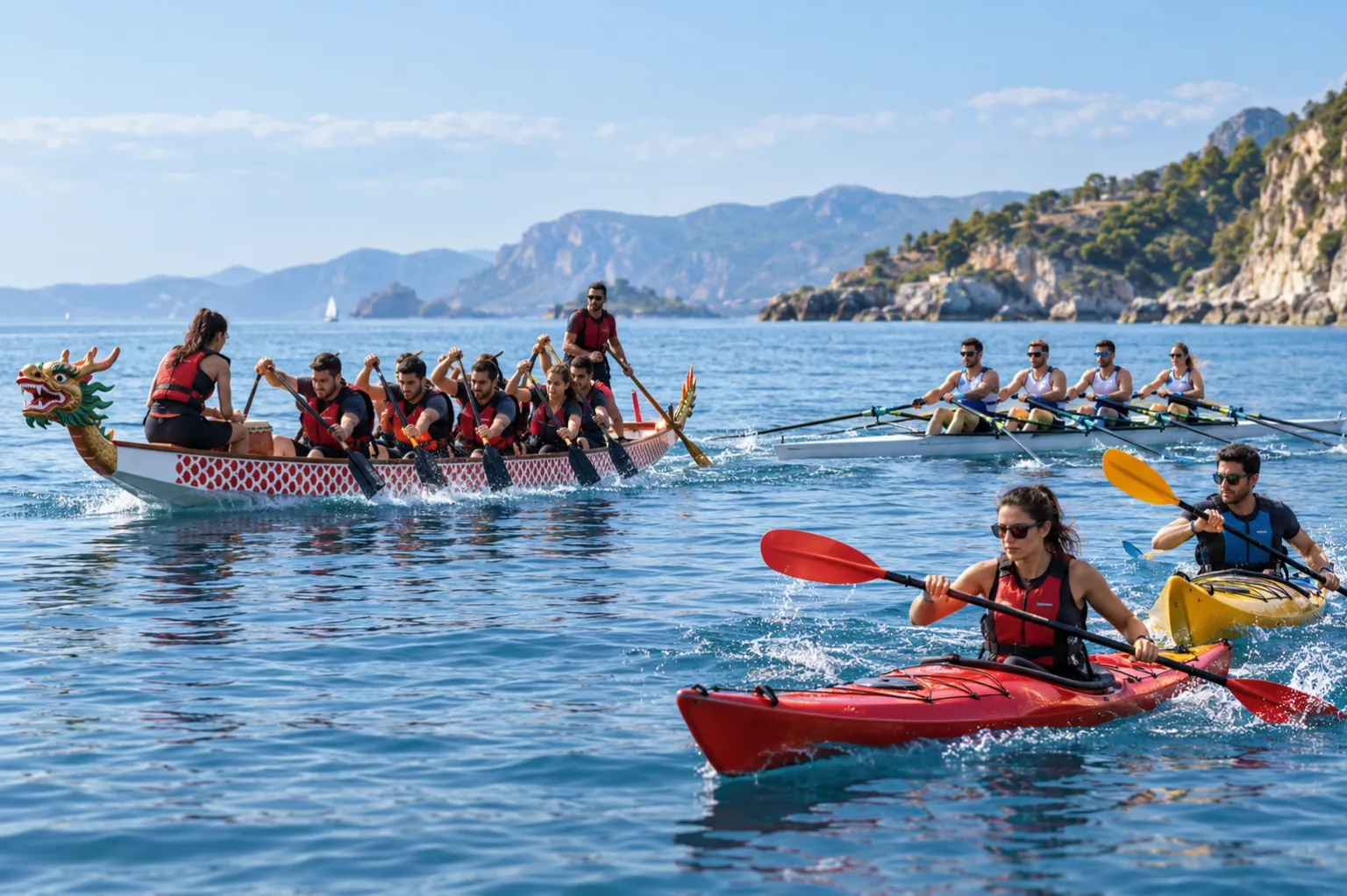
Dragon boat, multi-seat rowing boat or sea kayak? A comparison of group size, learning curve, water conditions, team message and physical demand, and which fits Istanbul, Izmir, Bodrum or Antalya.
Short answer: For large groups with mixed fitness, a dragon boat is the easiest and most inclusive choice: anyone who can follow the drum joins the crew within minutes. For small and mid-sized groups who want a more technical experience and the message that “timing is speed”, a multi-seat rowing boat needs calm water but is the most rewarding format. For leadership teams and for exploring coves, a sea kayak, usually paddled in pairs, builds the rhythm between two people and leaves nowhere to hide.
This guide sets the three boat types side by side for HR teams and event planners choosing a water activity, including planners bringing international groups to Turkey (Türkiye). For all our rowing programmes, see our corporate rowing page. A few things are the same whichever boat you choose: instructors are on the water with every crew, life jackets are worn throughout, groups can range from 8 to 120 people, no experience is needed, and the session can finish with a friendly mini team race supervised by the instructors. It is a team game, not an official race.
The three boat types in brief
Dragon boat
A dragon boat is long, stable and carries a large crew, with a drummer at the front setting the beat for everyone. Even people who have never held a paddle find the rhythm quickly, because all they need to do is follow the drum and the person in front of them. That simplicity is the point: within the first few minutes, a group of strangers from different departments is moving as one crew. With several boats on the water, crews can race each other, which gives large events a natural competitive finale.
Multi-seat rowing boat
This is rowing in the classic sense. Balance and technique are noticeable, and timing matters on every stroke. Because the boat is more sensitive than a dragon boat, it needs calm water, which is why we usually row it in the morning and in sheltered areas. When it works, it is the format where the link between the team’s rhythm and the boat’s speed is felt most clearly: the moment the crew finds its timing, the boat suddenly runs.
Sea kayak
Sea kayaks, often called sea canoes in event programmes, are usually paddled in pairs, so the rhythm is built between two people. If one paddler speeds up, the boat veers off course, which tests communication immediately and in a very personal way. They are easy to manoeuvre in coves and suit small groups, leadership teams, or rotating stations within a larger event, where pairs can be deliberately mixed across departments or levels of seniority.
Comparison table
| Criterion | Dragon boat | Multi-seat rowing boat | Sea kayak |
|---|---|---|---|
| Group size | Large groups; several boats at once or in rotation | Small to mid-sized groups | Small to mid-sized groups; stations at larger events |
| Learning curve | Shortest: follow the drum | Longest: balance and technique | Medium: coordination between two people |
| Water conditions | Most tolerant, thanks to its stability | Needs very calm water | Sheltered coves |
| Team message | One beat, one crew; everyone follows the same drum | Harmony over horsepower; timing is speed | Trust and communication; nobody can hide |
| Physical demand | Low; effort is spread across a big crew | Medium; balance and seated position | Low to medium; pairs set their own pace |
| Non-swimmers | The most suitable option | Assessed in advance | Assessed in advance |
| Best for | Congress, resort and large incentive groups | Teams who want a real taste of rowing | Leadership teams, exploring coves |
We ask about swimming ability when names are collected and allocate seats accordingly. Non-swimmers can take part comfortably in stable boats such as dragon boats, so nobody has to sit out.
What each format teaches a team
All three are team activities, but they put the emphasis in different places, and that is worth considering if the session is part of a wider programme with a message.
- Dragon boat: alignment. One drum, one beat. The lesson is that a big group moves fastest when everyone commits to the same rhythm, and that the person setting the tempo carries real responsibility.
- Rowing boat: harmony over horsepower. The strongest rower pulling out of time makes the boat slower, not faster. It is a vivid way to show that individual effort only counts when it is coordinated.
- Sea kayak: trust between two people. Every change of direction has to be agreed. It works well for pairing people who need to work together more closely, such as a manager and a new team lead.
Which boat in which location?
| Location | Water character | Leading format |
|---|---|---|
| Istanbul, Bosphorus | Never the main channel; sheltered coves on the European or Asian shore, early morning | All three, depending on the day and the group |
| Golden Horn | Among the calmest, most rowing-friendly water in Istanbul | Multi-seat rowing boats; good for beginners |
| Izmir | Calm morning water in the bay; sheltered coves at Urla and Çeşme | Rowing boats in the bay, kayaks in the coves |
| Bodrum | Sheltered bays chosen according to the wind, mornings | Sea kayaks; dragon boats for larger groups |
| Antalya | Wide beaches and the coves around Kemer; a long season | Dragon boats for large groups, kayaks for small ones |
Istanbul: the Bosphorus
The Bosphorus is an international shipping lane with strong currents and ferries crossing every few minutes, so corporate rowing never takes place in the main channel. Instead, crews work in sheltered coves on short courses parallel to the shore, early in the morning before the wind picks up and the water gets busy. The most popular format starts with a Turkish breakfast by the water and moves straight on to the boats. See our Istanbul rowing experience.
Istanbul: the Golden Horn
If your team has never rowed, or you want a more technical session, the Golden Horn is often the better choice. Its calm water makes multi-seat rowing boats possible, and on a breezy morning when the Bosphorus is choppy, the Golden Horn often still offers a workable course. Crews launch from a rowing club facility with the skyline of Fener, Balat and Eyüp around them. See our Golden Horn rowing experience. One note for planners: we do not run rowing programmes at the Princes’ Islands; for the islands, we recommend sailing.
Izmir and the peninsula
Izmir rowing almost always happens in the morning, because the imbat, the afternoon sea breeze, roughens the water later in the day. The calm morning water of the bay suits rowing boats, while the coves of Urla and Çeşme suit kayaks. When the wind arrives in the afternoon, the group can switch to something that benefits from it, such as sailing. See our Izmir rowing experience.
Bodrum
The peninsula’s sheltered bays make sea kayaks the most common choice, with dragon boats for larger groups. Summers are hot and the meltem tends to build in the afternoon, so sessions start early. If your hotel sits on a suitable stretch of sheltered shoreline and the hotel agrees, we can bring the boats to the beach and launch straight from the water in front of the hotel. See our Bodrum rowing experience.
Antalya
Antalya’s strengths are its long season and how easily a session fits into a resort or congress schedule. On Konyaaltı and wide hotel beaches, several dragon boats can take a large group onto the water at the same time or in rotation, while the coves around Kemer suit kayaks for smaller groups and leadership teams. See our Antalya rowing experience.
How it compares with sailing
Rowing and kayaking are short, intense formats in which the team moves under its own power and a shared rhythm. Sailing, by contrast, is about working with the wind, sharing roles on a yacht and a longer, more relaxed day. For a detailed comparison of the two, read our article on corporate sailing or rowing. A practical rule of thumb: in places like Izmir and Bodrum, where the wind is calm in the morning and stronger in the afternoon, rowing in the morning and sailing in the afternoon makes an excellent pairing.
Five questions to choose the right boat
- How many people? Dragon boats for large groups; rowing boats or kayaks for smaller ones.
- How mixed is the fitness level? In very mixed groups, a dragon boat spreads the effort across the crew.
- What message do you want? “One team” points to a dragon boat, “harmony over horsepower” to a rowing boat, “trust and communication” to kayaks.
- What water is available? Without calm water, a multi-seat rowing boat becomes difficult.
- How does the rest of the day look? A morning session can lead into meetings, a sailing afternoon or a treasure hunt.
Practical notes for the day
- Timing: across Turkey the standard window for water activities is April to October, and almost all sessions are scheduled in the morning, when the water is calmest.
- Clothing: quick-drying sportswear, shoes that can get wet, sun protection and a change of clothes. Life jackets are provided.
- Briefing language: English, Turkish or bilingual, confirmed in advance.
- Weather: we watch the wind and sea forecast in the days before the event and agree a decision time and a back-up date with you.
What shapes the quote
We do not publish fixed prices. The quote depends on the number of participants and, from that, the boat type and number of boats; the location (a club facility, a hotel beach or a cove); session length and whether a mini team race is included; breakfast or refreshments; transfers; and briefing language. Every proposal includes a decision time and a back-up date.
If you would like help choosing the right boat and location for your team, explore our corporate rowing programmes and send your numbers, city and dates through our quote request form. We reply within 24 hours with an itemised proposal.
Leave a Comment