
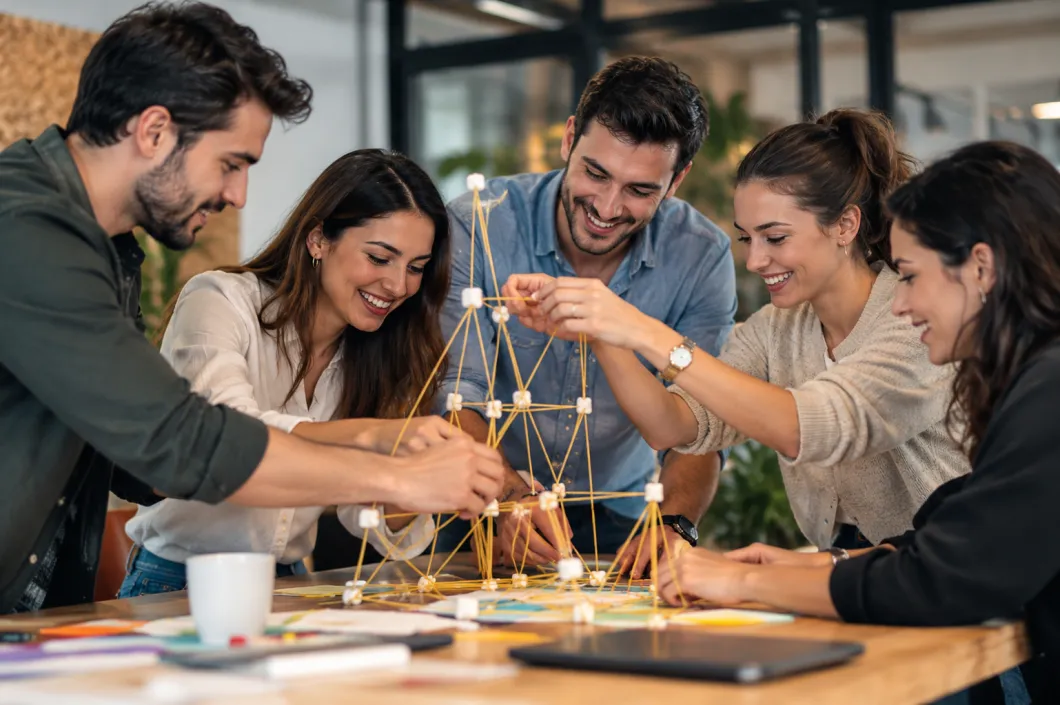
What does team building mean, what is it for and what is it not? The definition, goals, seven main types, how to choose by goal, a light way to measure it and the most common mistakes in one guide.
Short answer: Team building means deliberately developing a group of people into a team that works well together. In Turkish it is usually rendered as “takım kurma” or “takım oluşturma”, and in HR circles as “ekip geliştirme”. It is a set of planned activities that strengthen trust, communication, role clarity and a shared sense of purpose. The aim is not simply to have fun, but to improve collaboration in a tangible way through an enjoyable experience.
This guide answers “what is team building and what does it mean?”, then covers the main types, how to choose one by goal and how to measure the result. If you would rather go straight to formats that suit your company, our corporate team building activities page lists the options and group sizes.
What does team building mean?
The phrase combines “team” and “building”: the work of forming and strengthening a team. In Turkish, the most common equivalents are:
Takım kurma: The most widely used term, especially for events and organised activities.
Takım oluşturma: Heard more often for newly formed or restructured teams.
Ekip geliştirme: Used in HR and training, where the emphasis is on process and development.
In everyday Turkish business language the English term “team building” is also widely used; “team building activities”, “team building event” and “takım kurma aktiviteleri” all refer to the same thing.
What is team building, and what is it not?
Team building is an activity designed around a specific team challenge or objective, built on a shared task, and leaving behind something the team can take back to work. Participants need to depend on one another: the task should not be solvable alone, and should require communication and a division of labour.
The following do not automatically count as team building:
A party or dinner: Good for socialising, but there is no shared task or goal.
An unplanned fun day: It can be enjoyable, but without a purpose or follow-up its effect ends with the day.
Purely individual competition: When everyone plays for themselves, the individual stands out, not the team.
A compulsory, one-off “morale day”: If there is a trust problem in the team, it will not fix it on its own.
That does not mean fun is unimportant. A good team building activity is enjoyable; the difference is that the fun serves a purpose.
What are the goals of team building?
Building trust: Making it easier for team members to rely on one another and hand over tasks.
Strengthening communication: Practising clear speaking, listening and feedback under pressure.
Clarifying roles: Making visible who contributes which strengths.
Connecting departments: Bringing together teams that rarely work side by side.
Settling new teams quickly: Creating a common language during mergers, restructuring or rapid hiring.
A shared sense of purpose: Getting the team to plan and execute together in order to win.
Supporting engagement and belonging: Helping employees feel part of a team.
When should companies do team building?
Team building is always useful, but at certain times its effect is much more noticeable:
A new team or a new manager: A shared experience in the first weeks shortens the getting-to-know-you phase.
Mergers and restructuring: It helps teams from different cultures find common ground.
After an intense project period: It brings the team back together and marks the move into a new phase.
Friction between departments: Playing in mixed teams on the same pitch softens the prejudices of day-to-day work.
Hybrid and remote working: For teams that rarely meet in person, planned get-togethers are the most direct way to build connections.
The start and end of the year: A short activity added to goal-setting or year-end meetings makes the meeting itself more productive.
What are the types of team building?
Team building activities vary widely in length, venue and intensity. The table below summarises the seven most common types:
| Format | Typical length | Suitable group size | What it is good for |
|---|---|---|---|
| Short in-office activities | 10–90 minutes | From small teams to large offices | Icebreaking, getting acquainted, meeting energy |
| Outdoor activities | Half a day | Small and medium groups | Communication, division of labour, a change of scene |
| Sport-based tournaments and leagues | Half a day to a full season | Medium and large groups | Cross-department ties, regular contact, team identity |
| Experience / adventure activities | Half a day to a full day | Small and medium groups | Trust, stepping out of the comfort zone, a shared story |
| Training / workshops | 1–3 hours | Small and medium groups | A specific skill: communication, coordination, problem solving |
| Retreats (camps, offsites) | 2–3 days | Leadership teams and departments | Strategy, deeper relationships, planning a new period |
| Social responsibility activities | Half a day | Varies | Shared values, meaning and company culture |
For options you can run inside the office, see our post on office teamwork games and 12 corporate sports activities; for the most effective sports, see our guide to 10 corporate team building sports that strengthen team spirit.
Examples of team building activities
Each type includes many options. A few common examples to give you ideas:
In the office: The human knot, the marshmallow challenge, the silent line-up, a table tennis or darts tournament.
Outdoors: A company olympics, ultimate frisbee, archery, bumper ball.
Sport-based: Futsal, volleyball and padel tournaments; inter-company leagues that run for a whole season.
Experiences: Rafting, rowing, sailing, escape rooms, city orienteering.
Retreats: Two- to three-day programmes combining yoga, trekking and strategy sessions in nature.
For a list of 30 ideas with time, headcount and venue, see our post on team building games and activities.
How do you choose team building by goal?
The most common mistake is choosing the activity first and looking for a purpose afterwards. Reverse the order: write down what you want to change in the team, then choose the format.
| Goal | Suitable format | Example |
|---|---|---|
| Helping a new team get to know each other | Short office activities + a light half-day sport | Bocce, archery, introduction games |
| Cross-department communication | Tournament with mixed teams | Volleyball, padel, table tennis tournament |
| Coordination and rhythm | Water sports that need synchronisation | Rowing, sailing |
| Problem solving | Task-based experience | Escape room, orienteering, treasure hunt |
| Aligning the leadership team | Retreat | A 2–3 day programme in nature |
| A celebration with broad participation | Sports day, company olympics | A sports festival with stations |
A few examples: for a team that needs to work on coordination, a corporate rowing team is a strong option, because the boat only moves when everyone pulls in the same rhythm. Corporate sailing programmes, with an instructor on every boat, make role allocation and communication visible even in teams with no sailing experience. If you want more structured learning, the Teamwork and Coordination programme combines sport with a workshop. For a leadership team, a corporate retreat offers a better framework. If you are planning a one-day event with broad participation, take a look at our company sports event formats.
How do you measure the impact of team building?
You do not need a complex system to measure a team building event. A light but consistent approach is enough:
Pre-event survey: A week before the event, send a short survey of three to five questions, for example: “I can easily reach someone in another department” or “I feel comfortable sharing my ideas in my team.”
Participation tracking: Note how many people were invited, how many attended and how many stayed until the end.
Post-event survey: Ask the same questions again a few weeks later, and add an open question such as “Is there anything from this event you have taken back to work?”
Manager observation: Ask team leads to jot down any changes in collaboration they notice in the following weeks.
Interpret the results by comparing them with the previous period, not as a single number. For a fuller framework, read our post on measuring the return on a corporate sports event.
Common team building mistakes
Planning without a goal: An event that starts with “let’s do something” is usually forgotten.
Ignoring differences in fitness: An activity that only suits the sporty leaves everyone else on the sidelines.
Keeping departments together: Existing relationships stay exactly as they are; build mixed teams.
Squeezing it into personal time: A compulsory event at the weekend or late in the evening can breed reluctance.
Skipping the wrap-up: Without a short debrief at the end, the learning does not reach the workplace.
Thinking one-off: Small steps spread across the year can last longer than one big annual event.
Team building, takım kurma or team bonding?
These terms are often used interchangeably, but there are nuances:
Team building / takım kurma: An activity aimed at team performance, with a goal and a shared task.
Team bonding: Relaxed, fun-focused get-togethers centred on social connection: dinners, picnics, shared hobbies.
Team development (ekip geliştirme): A broader process over time that may include training and coaching.
In practice, the best results come from programmes that consider all three: social bonding lays the groundwork, a task-based activity tests collaboration, and regular repetition makes it stick. For example, a team building day at the start of the year, followed by a small office activity every month and a social get-together in the summer, can leave a more lasting impression on the team than a single big event.
Team building with Kurumsal Sporlar
Since 2015, Istanbul-based Kurumsal Sporlar has organised sport-based team building events for companies. We work across more than 50 sports, in all 81 provinces of Türkiye and abroad, and design programmes at every scale, from small teams to groups of thousands. Proposals are prepared within 24 hours, itemised line by line.
Your goal, headcount and preferred dates are enough for a first conversation. You can explore the options on our corporate team building activities page or get in touch with us directly.

Leave a Comment