
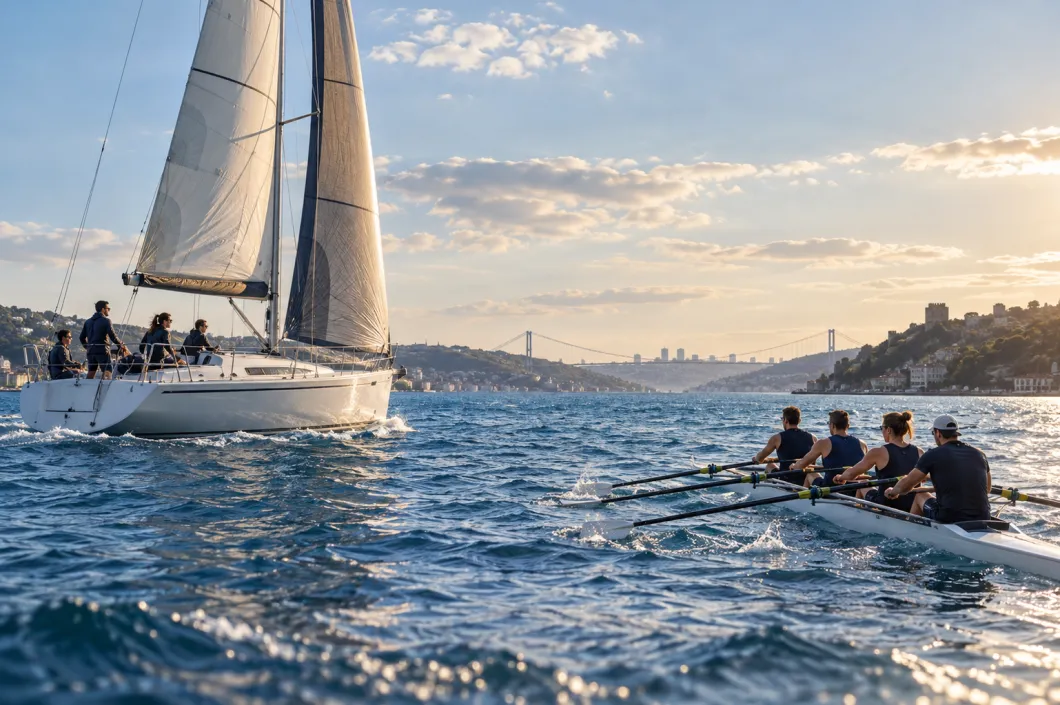
Sailing or rowing for your company water sports day? We compare both formats on roles, rhythm, group size, weather and location, and offer six questions to help you decide.
Short answer: If you want your team to take on different roles and make split-second decisions together, and the event is a reward or prestige programme, sailing is the better fit. If you want a high-energy day where everyone does the same thing at the same time and rhythm turns directly into speed, rowing (especially dragon boat) comes out ahead. You can also combine both in a single day.
When planning a company water sports day, these two formats usually end up on the same shortlist. Both happen on the water, neither requires experience, and both make teamwork visible in a very concrete way. But the experience they give a team, and what they demand operationally, are quite different. The comparison below is designed to help you decide based on what you actually want to achieve.
Sailing and rowing side by side
| Criterion | Sailing | Rowing (dragon boat, canoe, classic shells) |
|---|---|---|
| People in one boat | 6–8 per yacht on 38–45 ft boats, with an instructor on every yacht | 10–20 paddlers at once in a dragon boat; pairs in a canoe; 4–8 plus a cox in classic shells |
| Physical demand | Task-based: short bursts of effort on lines and winches, while the helm calls for focus and coordination | A whole-body sport, but the pace is kept low while learning and individual strength differences do not show in a dragon boat |
| Learning curve | After a short safety and role briefing, first-timers take on a job; the instructor handles technical control | A dragon boat moves smoothly within minutes; classic shells need three or four sessions for real progress |
| Weather and wind dependency | Needs wind; if conditions exceed safe limits, a backup date or an indoor format is used | Run in sheltered bays and lakes, never open sea; if conditions are poor the route is shortened, and instruction can move entirely onto ergometers |
| Role variety / leadership metaphor | Distinct jobs such as helm, jib trimmer, mainsail trimmer and pit; strategy, tactics and delegation | A few clear roles: the cox steers and gives commands, the stroke or drummer sets the pace |
| Synchrony / rhythm metaphor | Different tasks connecting at exactly the right moment | Everyone pulling in the same rhythm; alignment converts directly into speed |
| Locations (Istanbul and beyond) | Kalamış and Fenerbahçe marinas, the Princes’ Islands course and the Bosphorus in Istanbul | The Golden Horn and sheltered inlets in Istanbul; lakes Sapanca and Iznik; marina areas on the Aegean and Mediterranean coasts |
| Group scale | 4–150 people in total: a group of four can do training or a boat day on one yacht; larger groups take part in a mini sailing skills race across several boats | The largest crew in a single boat; several boats allow a route race between teams |
| Ideal duration | Half day (around 3–4 hours): briefing, manoeuvre practice, mini sailing skills race and prize-giving | Half day (3–4 hours) for instruction or a route; a full day at lake venues once travel is included |
When is sailing the right choice?
When strategic decisions and delegation matter
On a sailing yacht, nobody does the same job. The helm holds the course, the jib trimmer reacts instantly to the wind, the mainsail trimmer balances the power. These tasks have to connect at the right moment; when one person is late, the boat loses speed. That makes sailing a strong metaphor for teams built from different specialisms: leadership groups, project teams and companies that want to strengthen cross-department collaboration will find it generates more to talk about afterwards.
When you want people to rotate through leadership roles
In an instructor-led mini sailing skills race, jobs can be swapped between legs. A manager who makes decisions all day moving to the lines, or a junior colleague taking the helm, gives the team a view from outside the usual hierarchy. Because the instructor on board handles safety and technical control, participants can focus entirely on their own role.
When the event is a reward, incentive or prestige programme
A marina welcome, a mini sailing skills race on the water and a trophy ceremony afterwards leave a strong impression at sales incentives, year-end thank-you events or dealer gatherings. The Bosphorus and the Princes’ Islands course are memorable for the scenery as much as for the sailing.
When you are hosting international guests
For visiting delegations and multinational teams, a sailing programme run with English briefings and instructors becomes a way of seeing the city from the water. You can find the details on our corporate sailing page.
When is rowing the right choice?
When the goal is synchrony and shared rhythm
In rowing, individual superiority does not improve the result. Someone pulling harder than the rest does not speed the boat up; they unbalance it and slow it down. The moment the crew starts pulling at the same pace and the boat accelerates is usually the most talked-about part of the programme. If your message is “we move together”, it is hard to find more direct proof.
When you want a high-energy, physical day
Rowing works the whole body and everyone is active from start to finish; nobody is left waiting on the shore or on deck. Fitness is still not decisive: in a dragon boat the drummer sets the pace, and cox and shore-support roles are defined for participants with back or shoulder conditions.
When you want a large group in the same boat
A dragon boat ties 10 to 20 people to one rhythm in a single hull. For larger groups, several boats can go out and race each other along a route. If you want to see an entire department in one boat, this is where rowing clearly differs from sailing.
When you need a plan that depends less on the weather
Rowing programmes run in sheltered bays and on lakes. On flat water such as Lake Sapanca there are no waves or currents, so the risk of cancellation drops markedly. In the instruction format, the whole session can move indoors onto ergometers if the weather does not cooperate. All rowing formats are listed on our corporate rowing page.
When the target is a season, not a single day
Rowing lends itself well to becoming a company crew that trains regularly: cox and stroke roles are defined and the training plan is built backwards from a race at the end of the season. This approach is described in detail in the corporate rowing team programme. A similar season structure can be built in sailing with the corporate sailing team format.
Combining both: a mixed water day
If you are struggling to choose, combining the two formats in one day can work well. One possible structure:
Morning: A dragon boat warm-up on sheltered water. The team first learns to pull in the same rhythm; energy rises and the ice breaks.
Midday: Lunch on shore and a short debrief: “What changed once we found the rhythm?”
Afternoon: A mini sailing skills race. This time everyone takes a different job; rhythm gives way to strategy and delegation.
Close: A trophy ceremony and a short session comparing the two experiences.
This structure lets the team experience two dynamics in one day: what happens when everyone does the same job, and what happens when everyone does a different one. Whether it is feasible depends on location, group size and season.
Six questions to help you decide
What is the core message of the event? Strategy and shared roles point to sailing; alignment and common rhythm point to rowing.
How many people are coming, and does it matter that they share one boat? A dragon boat for one large crew; a sailing fleet for several small teams.
What is the participant profile? Is a physically demanding day right for everyone, or would a task-based, rotating structure be more inclusive?
How flexible is the date? If it is fixed, discuss weather-resilient formats and a backup plan up front.
Where will it take place? A marina in Istanbul or a lake outside the city? Travel time decides whether the programme is a half or full day.
Is this a one-off day or a season-long crew? If it is a season, plan the training rhythm and event calendar from the start.
Safety and participation
In both formats, safety is the organiser’s responsibility regardless of participants’ experience. In sailing, every yacht has an instructor on board, buoyancy aids are mandatory and a safety briefing is given before going out. The marine forecast is tracked for days before the event, and a pre-agreed backup plan is activated if conditions exceed safe limits.
In rowing, buoyancy aids are likewise mandatory for everyone. Wind and wave conditions are assessed on the morning of the event; if they are not suitable, the route is shortened or the programme postponed. Swimming ability is asked at registration and boats are allocated accordingly. Participants with back, shoulder or similar conditions should mention them in advance so that a suitable role can be defined for them in either format.
What drives the cost?
The cost drivers are similar for both formats: the number of participants and therefore the number of boats, programme length, location and transport, the instructor team, and extras such as catering, trophies and branded kit. When comparing two quotes, checking whether each of these items is included is the quickest way to compare like with like.
Conclusion
Neither sailing nor rowing is “better”; one simply fits the message you want to give your team more closely. If role variety, strategy and prestige matter most, choose sailing; if synchrony, energy and a large crew in one boat matter most, choose rowing. Your answers to the six questions above usually make the decision on their own.
Sharing your date, headcount and preferred location is enough for a concrete comparison of the two formats. The Kurumsal Sporlar team can put together a sailing, rowing or combined water day to fit your needs; send your request through our corporate sports quote form.


Leave a Comment