
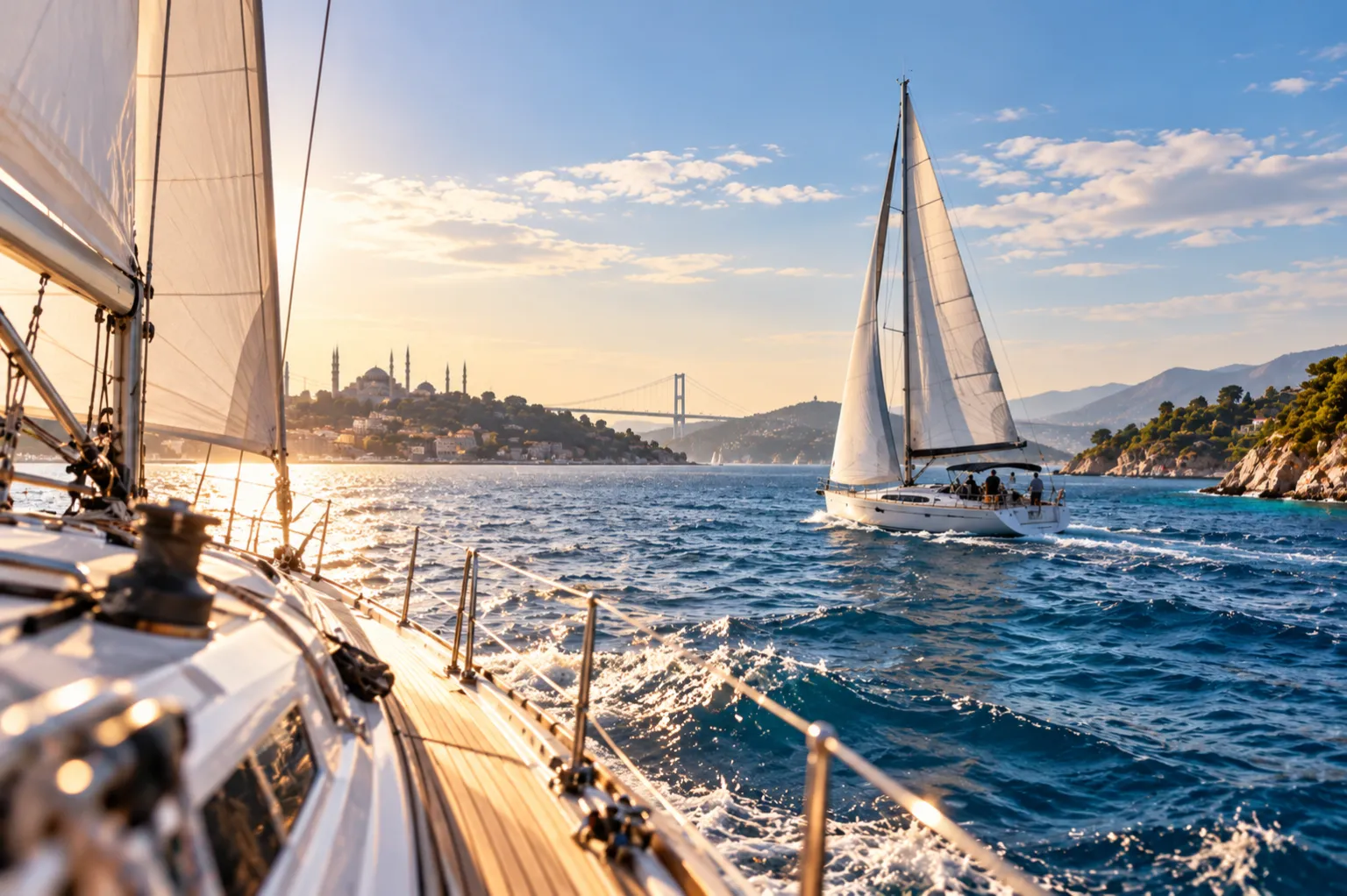
Where and when to sail in Turkey with a group: wind character in Istanbul, Çeşme–Urla, Bodrum–Gökova and Antalya–Kemer, a month-by-region table and how to match the region to your group.
Short answer: For groups, the sailing season in Turkey (Türkiye) runs broadly from April to October, and in most regions May, June and September are the most balanced months. Istanbul suits programmes that start in the middle of the city, an hour from the office or hotel; Çeşme and Urla on the Aegean suit teams who want steady wind and a proper feel for sailing; Bodrum and the Gökova side suit groups who want sheltered bays and a holiday rhythm; and Antalya–Kemer on the Mediterranean offers the longest season and fits easily around congress calendars. In July and August, plan to sail in the morning or late afternoon wherever you are.
This guide is written for event planners and HR teams, many of them based outside Turkey, who want to add a day on the water to a team programme and need to know where to go, when to go and which region fits which kind of group. If you already know you want sailing and are looking for formats, capacity and how we run the day, our corporate sailing page covers that. Here the focus is on geography, seasons and wind.
What stays the same wherever you sail
Before comparing regions, it helps to know which parts of a corporate sailing day do not change from one coast to another. Getting these clear early sets the right expectations with your stakeholders.
- An instructor on every boat. The instructor runs the yacht and keeps everyone safe; participants take turns at the helm and on the lines under their guidance. Nobody needs to have sailed before.
- A mini sailing skills race, not an official regatta. If you want a competitive element, the instructors set up a short course with manoeuvre tasks and a friendly mini skills race. It is a team game for beginners, not a sanctioned race.
- Groups of 4 to 150 people. For comfort we usually plan six to ten people per yacht. Larger groups are spread across several boats or two time slots, so half the group can be on the water while the other half does something else.
- The wind has the final say. Every programme has an agreed decision time and a reserve date, and the instructor can shorten the route or move it to sheltered water on the day.
The main sailing regions in Turkey
Istanbul and the Sea of Marmara: sailing through a city
What makes Istanbul unusual is that the boat sails through the middle of a city of millions. On one side you have the Maiden’s Tower and Seraglio Point, on the other the Moda headland and the Asian shore, and, when conditions allow, the bridges and waterside mansions further up the strait. Your team can leave the office or the hotel and be on the water within an hour, then be back in the city for dinner.
It is worth understanding how sailing in Istanbul actually works. The Bosphorus is an international shipping lane with heavy traffic and strong surface currents running from the Black Sea towards the Marmara. For that reason most of the sailing happens on the open water of the Marmara side and at the southern entrance of the Bosphorus. The run north towards the bridges is treated as an extension that the instructor adds on the day if wind, current and traffic allow, rather than a promise. You can read more on our Istanbul sailing experience page.
Many international groups stay around Sultanahmet, Sirkeci or Karaköy. For them, a Golden Horn departure keeps the whole day in one part of town. One thing to be clear about: because of the bridges across it, sailing yachts do not sail inside the Golden Horn. The group meets on the Golden Horn–Karaköy waterfront, and the sailing itself takes place at the mouth of the Golden Horn, at the Bosphorus entrance and on the Marmara side, which is also where you get the best view back towards the old city. See our Golden Horn sailing experience. For a full day with a swim and lunch at anchor, the Princes’ Islands sailing experience takes the yachts out to the bays of Heybeliada and Büyükada.
The Aegean: Çeşme and Urla for steady wind
The Çeşme peninsula west of Izmir is one of the best-known sailing and windsurfing areas in the country, largely because of its reliable summer wind. That makes it the region where sailing really shows itself: the boat heels, the sails load up and the team feels what it means to work with the wind rather than simply ride along. For complete beginners, mornings are usually calmer and afternoons livelier, so the timing of the session matters more here than anywhere else.
Urla, on the same peninsula but closer to Izmir, has a quieter, greener character with boutique hotels and vineyard-style venues. It suits smaller leadership groups who want a calm day with plenty of time to talk. For resort-based retreats, conferences and incentive groups, see our Çeşme corporate sailing programme.
The Aegean: Bodrum and Gökova for sheltered bays
The Bodrum peninsula has a jagged coastline full of small bays, which means there is almost always somewhere sheltered to anchor whichever way the wind is blowing. In high summer the northerly meltem tends to build in the afternoon, so Bodrum programmes usually leave in the morning, sail to a bay for a swim and lunch on deck, and return as the breeze picks up. The Gökova Gulf, to the east, is known for its green shoreline and quiet coves and tends to come into the conversation for longer programmes. Bodrum works particularly well for incentive and resort groups who are already staying on the peninsula; see our Bodrum corporate sailing experience.
The Mediterranean: Antalya and Kemer for the longest season
Antalya’s main advantage is the length of its season. April and May, September, October and, in many years, the first half of November are all excellent for sailing, and the sea is usually warm enough for most people to swim through much of that period. That makes Antalya one of the few places in Turkey where a corporate sailing day in late autumn is realistic, which is useful for congress organisers whose dates fall outside the peak summer months.
Short programmes can leave from the old harbour in Kaleiçi, with views of the old town and the cliffs, while full days usually start from a marina around Kemer, with the Taurus Mountains dropping straight into the sea behind you. From June to August the main factor is midday heat rather than wind, so we move the sail to early morning or late afternoon. Details are on our Antalya sailing experience page.
Wind character: poyraz, lodos, imbat and meltem
You do not need to be a sailor to plan a sailing day, but knowing the names of the main winds helps you talk to the instructor in the same language and understand why a plan changes. What follows is general character, not a forecast; the actual conditions are always decided by that week’s forecast and the instructor’s judgement on the day.
- Poyraz (Istanbul, north-easterly): the most common summer wind in Istanbul and generally good for sailing. Around the Princes’ Islands it can build a chop on the northern shores, so on poyraz days the yachts anchor on the southern, sheltered side.
- Lodos (Istanbul, south-westerly): can raise a short, steep sea on the Marmara side and at the Bosphorus entrance. It is the most common reason a route is shortened or a date moved, which is why a reserve date matters in Istanbul.
- Imbat (Izmir): the cooling sea breeze that typically sets in on summer afternoons and blows in from the sea towards the city. Mornings in the bay are usually calm, afternoons lively.
- Meltem (Aegean): the seasonal northerly of the Aegean summer, often at its strongest in July and August and in the afternoon. It is what makes Çeşme a sailing destination, and why sheltered bays matter so much around Bodrum.
- Mediterranean sea breeze (Antalya): a breeze that builds along the coast in the afternoon and on most days gives enough wind to sail properly, without the stronger character of the Aegean.
When to sail: month by region
The table gives a general direction for groups. It is based on the typical pattern of the seasons and does not guarantee the weather in any particular year.
| Period | Istanbul / Marmara | Aegean: Çeşme–Urla | Aegean: Bodrum–Gökova | Mediterranean: Antalya–Kemer |
|---|---|---|---|---|
| April | Season opens; cool, no swimming | Good; cool water | Good; calm bays | Very good |
| May–June | Most balanced period | Very good | Very good | Very good; watch the heat from late June |
| July–August | Morning or late afternoon; islands busy | Strong wind; beginners in the morning | Morning departures; afternoon meltem | Early morning or late afternoon; midday heat |
| September | Most balanced period | Very good | Very good | Very good |
| October | End of season; reserve date essential | Good | Good | Very good |
| November–March | Not recommended | Not recommended | Not recommended | First half of November possible in many years |
If you are planning a wider programme and want to see how sailing fits alongside other activities across the year, our guide to the best time for corporate events in Turkey looks at the calendar as a whole.
Matching the region to your group
| Group type | Suggested region | Why |
|---|---|---|
| Istanbul office, half day | Istanbul / Marmara | No overnight stay, back in the city for the evening |
| International group staying in the old city | Golden Horn departure | Old city in the morning, the water in the afternoon |
| Active team who want to feel the wind | Çeşme | Reliable wind and genuine sailing |
| Small leadership team or offsite | Urla, Princes’ Islands | Quiet, conversation-led day |
| Resort or incentive group | Bodrum, Antalya–Kemer | Short hotel transfers, bay stop and lunch on deck |
| Congress outside the summer peak | Antalya | Long season with flexibility into October and November |
Practical notes for groups travelling from abroad
- Airports and transfers: Istanbul has two airports on opposite sides of the city, so the choice of marina often depends on where you land and where you stay. Izmir serves Çeşme and Urla, Bodrum has its own airport, and Antalya’s airport is close to both the city and the Kemer coast.
- Traffic matters more than distance in Istanbul: we time departures to avoid peak traffic, because a short distance can take a long time at the wrong hour.
- Swimming: if a swim stop is important, choose your month accordingly. In Istanbul the sea is generally warm enough for most people from mid-June; in Antalya the swimming season runs well into autumn.
- Briefing language: safety briefings can be given in English, and we confirm the language for each boat in advance.
- What to bring: sun protection, a hat, soft-soled non-slip shoes, a light layer for the evening breeze and a change of clothes. Life jackets are provided.
A planning checklist
- Match your dates to the regional season first, then to the business calendar.
- Confirm numbers; the number of yachts follows from them.
- Choose the format: half day, full day, sunset sail with dinner, a short training session or a mini sailing skills race.
- If you want a swim stop, pick the month with water temperature in mind.
- Put a decision time and a reserve date in writing.
- Plan hotel–marina–restaurant transfers around traffic and group size.
- Send participants a short kit list and the meeting time a few days in advance.
What shapes the quote
We do not publish fixed prices, because every sailing day is built around the group, the region and the date. The main items that shape a quote are the number of participants and yachts, the length and format of the programme, the departure point and transfers, refreshments on board or lunch and dinner, photography and video, and how flexible your dates are. The region and month affect every one of these, so keeping your date range open at the first conversation usually leads to a better plan.
If you would like help choosing the right region and month for your team, have a look at our corporate sailing formats and send your numbers and date range through our quote request form. We reply within 24 hours with an itemised proposal in TRY, USD or EUR.


Leave a Comment