
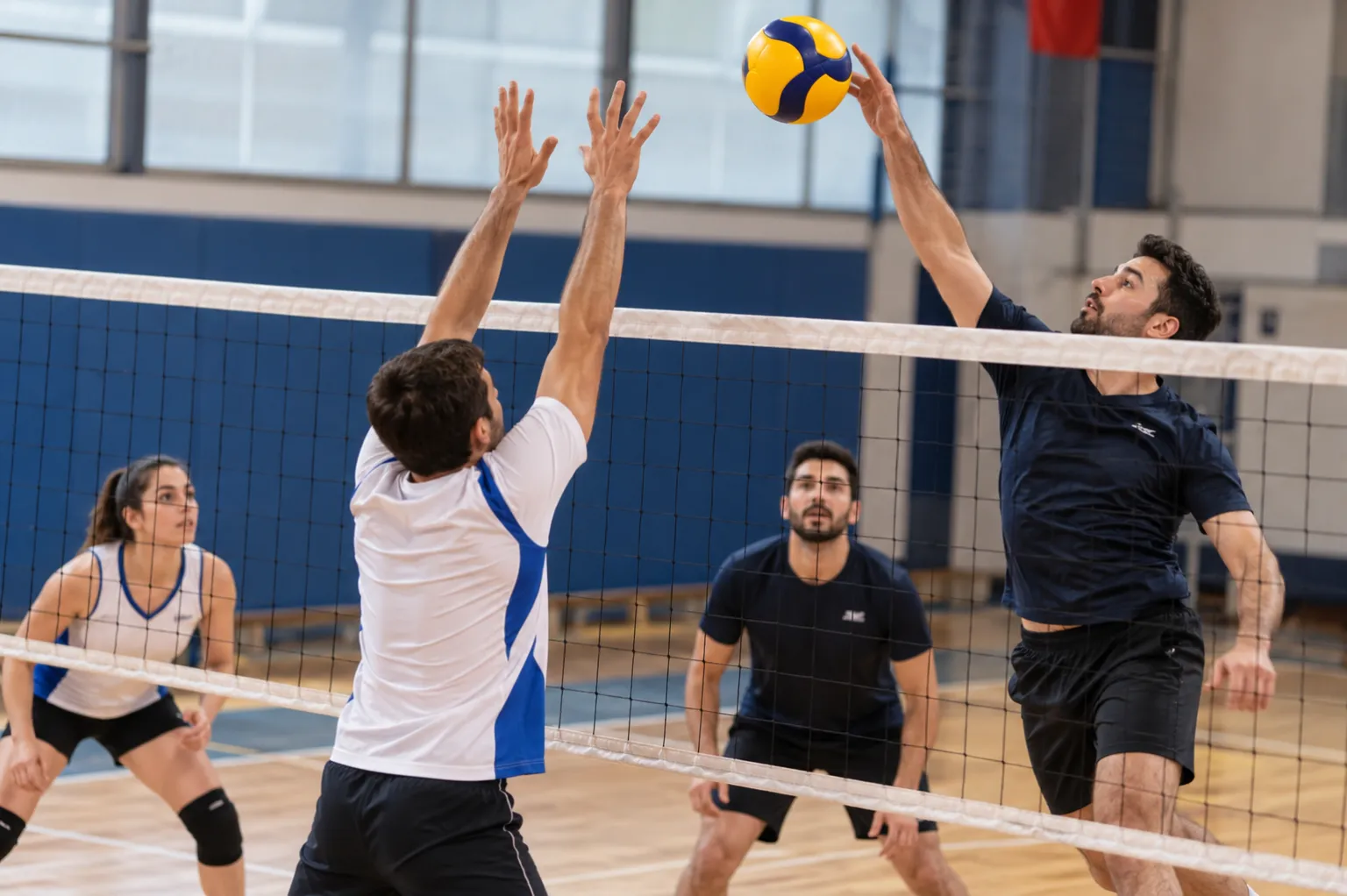
Volleyball rules in brief: sets and scoring, rotation, touches. Plus how to adapt them for a company tournament: shorter sets, mixed-team rules, easier serves, indoor vs beach, and a teams-courts-time table.
Short answer: in official volleyball, two teams of six play sets to 25 points, a set must be won by two clear points and the match goes to the first team to win three of five sets. Every rally scores a point, a team may touch the ball at most three times, and a team that wins back the serve rotates clockwise. For a company volleyball tournament these rules are usually shortened: sets to 15 or 21, matches over two sets, at least two women on court in mixed teams and, if needed, a second serve.
Volleyball is a strong choice for company tournaments: there is no contact, six people play per side and it is almost impossible to win a point without talking to each other. This guide first summarises the official rules, then sets out the adaptations we recommend for a company group with mixed ability. For general information on the sport, see our volleyball page.
Volleyball rules in brief (indoor)
Teams and court
- The court is 18 × 9 metres; the net is 2.43 m high for men and 2.24 m for women.
- Each team has six players on court: three in the front zone and three at the back.
- The libero is a defensive specialist in a different-coloured shirt who cannot serve or attack above the net. Company tournaments usually leave the libero out.
Sets and scoring
- Every rally wins a point for one team (rally point scoring), regardless of who served.
- A set is played to 25 points, but must be won by at least two (25–23, 26–24 and so on).
- Matches are best of five sets; the deciding fifth set is played to 15.
Touches
- A team may touch the ball up to three times before sending it over. A block touch does not count towards the three.
- The same player may not touch the ball twice in a row (except after a block).
- The ball must not be caught or thrown; it has to be cleanly hit. Any part of the body may play the ball.
- Touching the net during play, or crossing the centre line into the opponents' court, is a fault.
- A ball landing on the line is in.
Serving and rotation
- The serve is taken from behind the end line and players get one attempt. A serve that clips the net and goes over is good.
- A team that wins a point on the opponents' serve takes over serving and rotates one position clockwise, so everyone serves in turn and plays both front and back.
- Back-row players may not attack above the net from in front of the attack line, and may not block.
Adapting the rules for a company tournament
A five-set match under official rules can last more than an hour, and for inexperienced players the serving and rotation rules constantly stop play. At a corporate tournament the aim is flowing games where everyone gets touches on the ball. Our recommended adaptations:
- Shorter sets: two sets to 21 or a single set to 25 in the group stage, with a deciding set to 15 if needed. When time is tight, sets can be capped at a fixed score (for example 23 or 17) without the two-point margin.
- Time cap: a 20–25 minute limit per match protects the schedule; when time is up, the team in front wins.
- Easier serving: underarm serves are allowed; first-timers can serve from a few steps inside the end line or get a second serve.
- Relaxed rotation: keep the rotation rule, but treat position faults (players standing in the wrong order at the serve) with a warning only.
- Flexible squads: add two or three substitutes to each team of six, with unlimited changes between sets, so everyone gets on court.
- Refereeing: one referee per match is enough; in large tournaments, teams without a match can provide the referee and scorer, which also helps people mix.
Mixed volleyball rules for work
Most company tournaments use mixed teams. Common mixed volleyball rules include:
- At least two women on court (in a team of six). If a team is short of women, it plays a player down rather than adding another man.
- Net height: in mixed games the net is usually set between the men's and women's heights, at around 2.35 m.
- Touch rule (optional): when a team uses three touches, at least one must be by a woman. This can slow the game, so use it only when there is a clear gap in ability.
- Attack limit (optional): extra rules, such as men not spiking from the back row, stop a few experienced players from deciding matches on their own.
Share the rules you will use in writing at registration; changing them mid-tournament invites disputes.
Indoor or beach volleyball?
Beach volleyball is played in pairs on a 16 × 8 m sand court. Sets go to 21, matches are best of three and the deciding set goes to 15. There is no positional rotation, but the serve alternates between the two players, and teams switch ends every seven points (every five in the deciding set). Setting the ball with the fingertips is judged more strictly than indoors; for corporate games this can be relaxed. At company events, teams of four rather than pairs let more people play at once.
Indoor volleyball is weather-proof and can be planned in any month; beach volleyball comes into its own in summer, combined with a picnic, a beach day or a hotel event. For summer events, see our beach volleyball event page.
Teams × courts × time
The table below gives an approximate plan for a one-day tournament with a group stage and knockout rounds, assuming 20–25 minutes per match and five minutes between matches:
| Teams | People (with subs) | Courts | Format | Total time |
|---|---|---|---|---|
| 4 | 30–35 | 1 | Single round robin + final | 3–3.5 hours |
| 6 | 45–55 | 2 | 2 groups of 3 + semi-finals and final | 3–4 hours |
| 8 | 60–70 | 2 | 2 groups of 4 + semi-finals and final | 4–5 hours |
| 12 | 90–105 | 3 | 4 groups of 3 + quarter-finals | 5–6 hours |
| 16 | 120–140 | 4 | 4 groups of 4 + quarter-finals | Full day |
Adding courts is the most effective way to shorten the day. To build group and knockout pairings, use the templates in our guide on how to build a tournament fixture.
Group standings and tie-breaks
Define how groups are ranked before play starts. A common method: number of wins first, then set ratio (sets won divided by sets lost), then points ratio and finally the result between the tied teams. If matches are single sets, using points difference instead of set ratio is easier to follow. Put the rule in the rules sheet and update the standings after every match.
Volleyball tournament checklist
- Hall or sand court booking, net and post check, spare balls
- A rules sheet: set length, mixed rule, serving concessions, time cap
- Team lists and shirts or coloured bibs
- Referees, scoreboards and a visible standings table
- Warm-up time and a short stretching session to prevent injuries
- First-aid kit and a medic; on sand, a plan for sun and water
- Space for the award ceremony, plus trophies and medals
Common mistakes: Volleyball Tournament Rules
- Applying the official rules unchanged: five-set matches and strict serving rules mean inexperienced players barely touch the ball.
- Changing rules mid-tournament: if the mixed rule or set length changes halfway through, earlier results become contentious.
- Too few courts: running eight teams on one court drags the day out and drains waiting teams.
- Skipping the warm-up: for desk-based teams, jumping and sudden changes of direction carry injury risk; a ten-minute warm-up is essential.
- No substitutes: teams that lose players to injury or meetings during the day should not forfeit; name at least two substitutes per team.
From tournament to league
If the tournament goes well, volleyball can become a year-round routine: a company league with weekly matches keeps participation alive and makes cross-department connections last. We explain how that works on our corporate volleyball league page.
Conclusion: Volleyball Tournament Rules
A successful company volleyball tournament comes from knowing the official rules and simplifying them for your group: shorter sets, a mixed-team rule, easier serving and enough courts. For an end-to-end event indoors or on the beach, from the rules sheet to referees and the award ceremony, see our corporate volleyball tournament service, and share your date and number of teams to request a quote.



Leave a Comment