
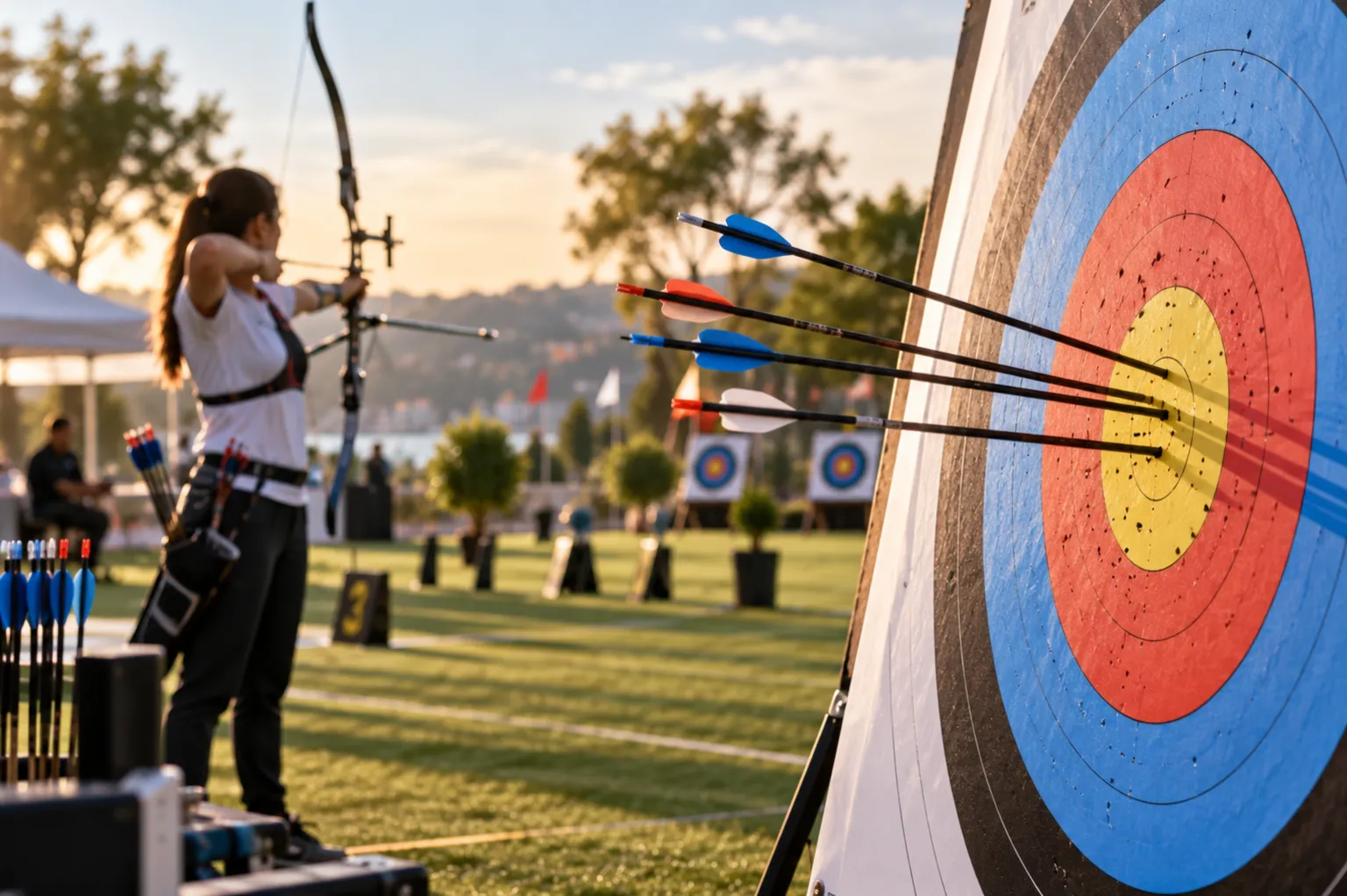
How archery is scored: 10 to 1 ring values, ends, arrows touching a line, tie-breaks, safety commands, whistle signals and how to adapt the rules for a company competition.
Short answer: In target archery the target has ten concentric rings: the centre is worth 10 points and the outermost ring 1 point, while an arrow off the target scores nothing. Arrows are shot in ends; after each end the scores are called at the target and the running total decides the ranking. An arrow touching the line between two rings scores the higher value. Ties are broken first by the number of 10s, then 9s, and if still level by a single-arrow shoot-off in which the arrow closest to the centre wins.
This guide explains the basic rules of archery competition in plain language: how the target is laid out, how scoring works, the logic of ends, tie-breaks, safety commands and whistle signals. The final section shows how the rules are adapted for a company competition. If you are new to the sport, start with our guide to what archery is.
What does an archery target look like?
A standard target face has ten concentric rings in five colour zones, with two rings in each zone:
| Colour zone | Rings | Points |
|---|---|---|
| Gold (yellow) – centre | Inner / outer | 10 / 9 |
| Red | Inner / outer | 8 / 7 |
| Blue | Inner / outer | 6 / 5 |
| Black | Inner / outer | 4 / 3 |
| White – outermost | Inner / outer | 2 / 1 |
| Off the target | — | 0 (M, miss) |
Inside the gold there is a smaller inner circle. An arrow there still scores 10 but is usually recorded as an X, which can be used to break ties. Indoor competitions often use a vertical triple face, three small target faces stacked on top of each other, to save space; the outer rings are left off and one arrow is shot at each face.
How is archery scored?
Scoring depends on where each arrow lands and rests on a handful of simple rules:
- The shaft is what counts. It is the point where the shaft enters the face that is scored, not the fletching or the tip.
- A line-cutter takes the higher score. If the shaft touches the line dividing two rings, the higher value is recorded. If in doubt, the judge or instructor decides before the arrow is pulled.
- No arrows are pulled before scoring. Scores are called at the target with the arrows still in place, written down, and only then are the arrows collected.
- Scores are written highest first. The arrows in an end go on the score card from the highest value down, which makes checking easier.
- Bounce-outs and arrows embedded in another arrow are generally scored by the mark left on the face or by the value of the arrow they lodged in. At corporate events these rare cases are settled by the instructor.
How ends work
Archery competitions are made up of blocks called ends. In each end every archer shoots a set number of arrows; then everyone stops, walks to the target, the scores are called and the arrows are collected. In general:
- At outdoor competitions an end is often six arrows.
- Indoor competitions and head-to-head matches commonly use three-arrow ends.
- Each end has a time limit; arrows not shot when time runs out do not score.
- A competition can run as a ranking round, the total of a fixed number of ends, followed by head-to-head elimination matches.
The end structure has a practical benefit too: everyone shoots together and collects together, so nobody ever walks to the target while others are shooting.
At busy competitions several archers share one target. They are split into details that take turns on the line: one detail shoots its end while the other waits behind the line, then they swap, and only when both have finished does anyone walk forward. Target and detail assignments are announced in advance, which speeds things up and prevents mix-ups on the score cards. At corporate competitions the same pattern is used, with team members taking turns at the same target.
How to keep a score card
Each target has a score card with a row for every archer, a column for every end, and boxes at the end for the running total and the number of 10s and 9s. At the end of each end the archers walk to the target together; each archer calls their own arrows from highest to lowest, the scorer writes them down and the others listen and check. If the three arrows in an end landed in the 9, the 7 and the 10, it is recorded as "10 – 9 – 7, end total 26". Each end total is added to the previous one to give the running score. At the finish, the archer and the scorer both confirm the card; at official events an unsigned card may not count.
How team scores are calculated
Team competitions usually use one of two methods. In the first, every team member shoots the ranking round individually and the members' totals are added together to give the team score. This is the simplest and fairest approach for corporate competitions because every arrow from every person counts. In the second, team members shoot in turn within the same end and the end is scored as a shared team end; this is more exciting but needs coordination and timing within the team. Whichever you choose, keep teams the same size or use average scores.
Elimination matches and the set system
After the ranking round, archers may face each other in head-to-head matches. In the set system commonly used for recurve bows, each set is three arrows; the winner of a set takes 2 set points and a drawn set gives each archer 1. The first to reach a set number of set points wins the match. Compound matches usually use the cumulative total of all arrows shot instead. At a corporate competition one method is chosen and explained clearly in the briefing.
How are ties broken?
When archers finish a ranking round on the same total, the usual order is:
- The archer with more 10s goes ahead (some events also count Xs).
- If still level, the number of 9s is compared.
- If still level, particularly for elimination places and medals, a single-arrow shoot-off is held: the highest score wins, and if the scores match, the arrow closest to the centre wins.
Safety commands and whistle signals
The shooting line at an archery competition is controlled by voice commands or a whistle. The pattern widely used at international events is broadly as follows; at corporate events the instructor uses a similar system with spoken commands:
| Signal | Meaning | What the archer does |
|---|---|---|
| Two blasts | Come to the shooting line | Moves from the waiting area to the line without nocking an arrow |
| One blast | Shooting may begin | Nocks and shoots within the end's time limit |
| Three blasts | Shooting is over, go to the target | Puts the bow down and walks forward to score and collect |
| A series of blasts | Emergency, stop shooting at once | Stops, takes the arrow off the string and waits for instructions |
Whatever the signals, these core rules always apply:
- An arrow is only nocked on the shooting line, with the bow pointing at the target.
- Nobody steps in front of the line; arrows are collected only once everyone has finished shooting.
- Nobody stands behind someone pulling arrows from the target, because the shaft can come out fast.
- A dropped arrow is not picked up while shooting is under way; it is collected at the end of the end.
- Arm guards are worn, and alcohol is not allowed before or during the event.
How does an archery competition run? Step by step
- Registration and categories: archers are grouped by bow type (recurve, compound, traditional) and, if needed, by experience.
- Equipment check and briefing: rules, safety and signals are explained.
- Practice ends: unscored warm-up arrows let archers get used to the distance and target.
- Ranking round: a fixed number of ends is shot and each one is recorded.
- Elimination matches: pairings are drawn from the ranking and winners advance.
- Final and awards: the final matches decide the champion.
Adapting the rules for a company competition
Official rules are written for experienced archers; at a corporate competition the goal is for everyone to learn and compete happily on the same day. A few adjustments are therefore made:
| Element | Typical official practice | Company competition adaptation |
|---|---|---|
| Distance | Long distances by category | 10 to 18 metres; beginners shoot at a closer target |
| End | Three or six arrows | Usually three arrows, which keeps things moving |
| Ranking round | Many ends | A few ends, then a short final |
| Categories | Bow type, age, gender | Beginner / experienced, individual / team |
| Team score | Separate team events | Scores of three or four team members are added together |
| Commands | Whistle and timer | Instructor's spoken commands, a whistle if needed |
A few small touches make a company competition more enjoyable: keep a live leaderboard on screen, add non-technical awards such as "most improved archer", and hold the final where everyone can watch. For a detailed comparison of formats and who does what, see our corporate archery tournament page. If you want to build the bracket yourself, our guide to creating a tournament fixture will help, and our tournament award and trophy ideas cover the prizes.
Common mistakes
- Explaining the rules after shooting has started: if the line-cutter and tie-break rules are not set out at the start, results turn into arguments.
- Pulling arrows before scoring: once an arrow is out, its score cannot be checked again.
- Skipping practice ends: nerves run high in the first ends and the ranking becomes unfair.
- One person both shooting and keeping score: appointing a scorer at each target keeps the records reliable.
If you would like to turn archery into a properly scored competition for your team, we set up the targets, instructors, score cards and safety layout. Browse the formats on our archery page, see our internal company tournament page to combine it with other sports, and send us a quote request.


Leave a Comment