
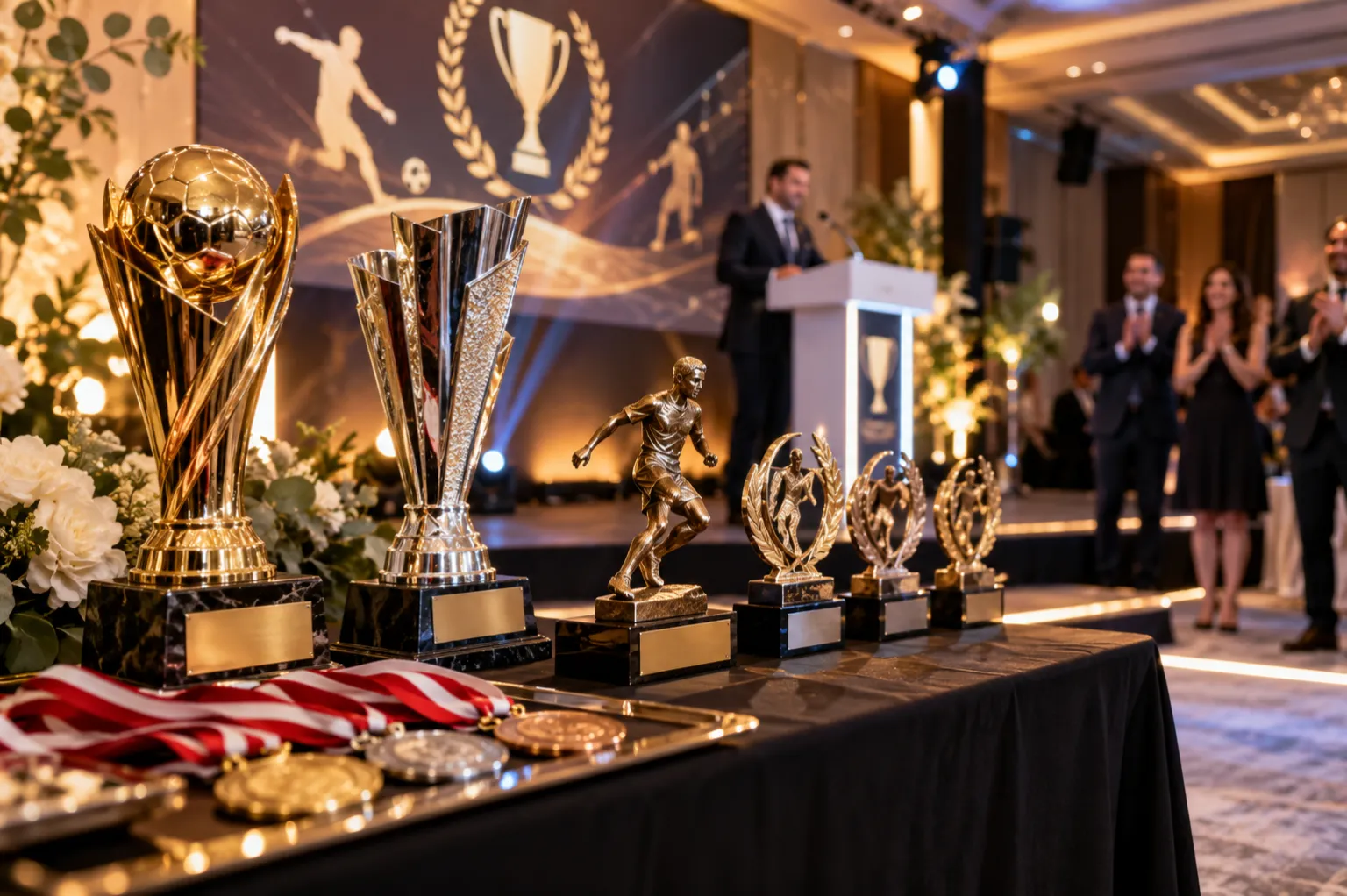
How to choose prizes for a company tournament: award categories from champions to fair play, trophies and medals versus experience prizes, personalisation, a ceremony running order and inclusion.
Short answer: a good prize plan for a company tournament rewards not just the winners but the behaviour you want to see. Choose at least one performance award (champions, runners-up, third place), one behaviour award (fair play) and one participation award (best supporters, most improved). Trophies and medals leave a lasting keepsake, while experience prizes bring the team back together. Present them all in a 20–30 minute ceremony with a running order written in advance.
The last half hour of a tournament is one of the moments people remember first. A well-planned award ceremony gets talked about for weeks; a rushed handout drains the energy from an otherwise good day. This guide covers award categories, prize types and the ceremony running order for HR teams planning an internal sports tournament or an inter-department contest.
Start with a question: what do you want to reward?
Prizes are a way of saying, in front of everyone, what the company values. Reward only the score and the message is "winning is everything"; reward sportsmanship, support and progress too and the message becomes "we play together here". If the tournament is about connection and belonging, at least half of your awards should have nothing to do with the score.
Award categories
Performance awards
- Champions: the main trophy of the tournament, with medals for the whole squad and a trophy for the team.
- Runners-up and third place: medals or a smaller trophy. With a large field, people expect the top three to be recognised.
- Most valuable player (MVP): top scorer, most points, highest bowling game, depending on the sport. Announce the criteria in advance.
Behaviour awards
- Fair play award: the team that showed the most respect for the rules and their opponents, chosen by referees and organisers or by teams scoring each other. Presenting it just before the main trophy underlines its importance.
- Team spirit award: the team that backed each other even in defeat and rotated players so everyone got time on the pitch.
Participation and progress awards
- Best supporters: pulls in colleagues who are not playing. Banners, chants and colour coordination can all count.
- Most improved player or team: the biggest progress from first game to last. A strong motivator for first-timers.
- Best team name or kit: builds excitement before the tournament; for inspiration, see our company team name ideas.
- Unsung hero: the volunteer organiser, the colleague who refereed, or the one who stepped in for an injured teammate.
Mixed-team awards
If teams are drawn from different departments, awards such as "best mixed team" or "team bringing together the most departments" make the real purpose of the tournament visible. If your rules encourage men and women or different levels of seniority to play together, celebrating that with an award turns a rule from an obligation into a value.
How many award categories are enough?
A practical rule of thumb: set roughly half as many categories as there are teams. In an eight-team tournament, three or four extra awards on top of the podium mean most teams get on stage at least once. Too many categories cheapen each award and lengthen the ceremony; above ten teams, giving some awards to teams rather than individuals keeps the balance. To stop one team collecting everything, you might also exclude podium finishers from the behaviour and participation awards.
Physical prizes or experience prizes?
They do different jobs, and the best results usually come from combining them.
| Prize type | Examples | Strength | Watch out for |
|---|---|---|---|
| Trophy | Metal, crystal or wooden trophy; perpetual trophy | Displayed in the office, a lasting keepsake | One per team; add medals for individual mementos |
| Medals | Ribbons in company colours, printed with the year and event name | Everyone takes their own keepsake home | Order extra to cover the full squad |
| Plaque and certificate | For fair play, MVP, unsung hero | Personal, written recognition | Keep the wording short and specific |
| Experience prize | Team dinner, first pick of sport at the next event, a workshop or class | Brings the team back together | Without a date it gets forgotten; put it in the diary |
| Purposeful prize | A donation in the company's name to a cause chosen by the winners | Turns winning into a shared good deed | Agree donation policy and process with HR and finance first |
| Visibility prize | Internal news story, champions' wall, photos | Reaches the whole company | Get participants' consent for photo use |
A perpetual trophy works especially well for recurring tournaments: it passes each year to the winning team or department, with the winners' names added to it. It creates a year-long friendly rivalry and boosts sign-ups for the next edition. Remember to check with HR and finance that prizes comply with your gift policy and any applicable rules.
Personalisation
- Engraving: tournament name, year, category and team name. Since you cannot engrave the winner before the final, order the trophy in advance and add the name plate afterwards.
- Company identity: brand colours and logo on medal ribbons and trophy bases.
- Team photo: a framed photo from the ceremony sent to each team stays on desks for a long time.
- Digital badge: a profile badge on your internal platform is a cheap, visible extra, especially for hybrid teams.
Allow for lead times: personalised trophies and medals need to be ordered several weeks ahead.
How to run an award ceremony
The longer a ceremony runs, the more attention drifts. The running order below takes 20–30 minutes:
| Time | Step | Who | Note |
|---|---|---|---|
| 3 min | Gather, music, call to the stage | Host | Start as soon as the final ends; a long gap and the crowd drifts away |
| 3 min | Short recap of the day and thanks | Host / HR | Thank referees, volunteers and the medical team by name |
| 5 min | Participation and progress awards | Host | Best supporters, most improved, team name |
| 4 min | Fair play and team spirit awards | Referee representative | Explain in one sentence why they won |
| 3 min | MVP and individual awards | Organising team | Criteria and numbers can be shown on screen |
| 5 min | Third place, runners-up and champions | Senior leader | Podium, medals, trophy and music |
| 5 min | Group photo and close | Photographer / Host | A good moment to announce the next event |
Building from the smaller awards to the biggest saves the excitement for the end and keeps everyone in the room until the ceremony is over. For tournaments near the end of the year, the ceremony can be combined with a dinner; see our year-end corporate events page.
Inclusion: prizes everyone can feel part of
- Do not reward physical performance alone: supporter, organiser and team spirit awards are realistic goals for colleagues who are not sporty.
- Prefer mixed categories: rewarding mixed teams rather than separate men's and women's categories keeps the competition without dividing the group.
- A memento for everyone: a participation medal or certificate for all players leaves a good impression, especially at a first tournament.
- Avoid alcohol and taste-specific prizes: choose prizes that everyone can use and value.
- Treat managers as players: senior leaders may present the awards, but teams they play in should be judged by the same rules.
Announce the prizes before the tournament
Sharing the award categories with the sign-up announcement boosts participation. Teams that know there is a "best supporters" award make banners, a "most improved" award encourages first-timers to register, and clear fair play criteria reduce arguments on court. Showing a photo of the trophy on internal channels a week before the event is a simple way to build anticipation.
What shapes the prize budget
The prize budget depends on the number of categories, team and squad sizes (how many medals), trophy material and size, engraving and personalisation, staging, sound and podium for the ceremony, a photographer and the scope of any experience prizes. Adding categories often reaches more people than a single big prize.
Common mistakes
- Setting criteria afterwards: announce MVP and fair play criteria before the tournament.
- Miscounting medals: include substitutes when working out how many you need.
- Postponing the ceremony to the next day: a prize has the most impact on the day, while the excitement is high.
- Leaving experience prizes undated: "we'll go for dinner sometime" rarely happens.
Conclusion
The prize plan is the final sentence of the tournament: the right categories, personalised trophies and a well-run ceremony carry two hours on the pitch into the company's shared memory. If you want awards to be part of a wider motivation programme, see our employee motivation events page; for an end-to-end event from fixtures to trophies, explore our tournament organisation services and request a quote.


Leave a Comment