
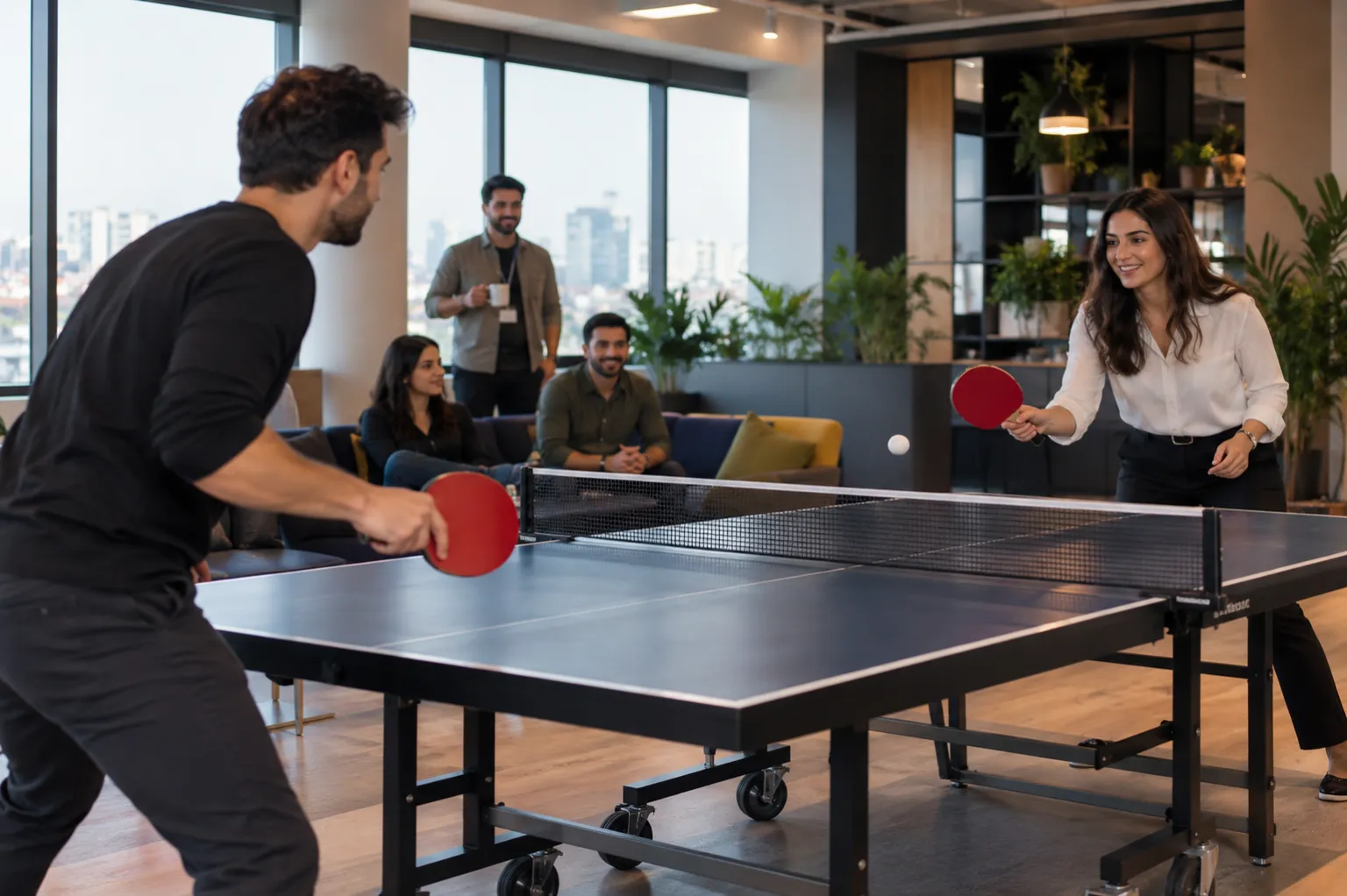
A guide to an office table tennis tournament: the rules in brief (11 points, serving), table and space planning, group plus knockout formats, a tables × players × time table and ways to balance ability.
Short answer: to organise a table tennis tournament, first work out how many tables you need for your headcount (roughly three to four matches per table per hour), then build a fixture with groups of three or four followed by knockout rounds. Matches are played to 11 points per game, best of three games, and the serve changes every two points. If abilities vary widely, a head-start handicap or separate ability draws keeps everyone in the game.
Table tennis (ping pong) is the most practical tournament sport for the office: a single table fits in a meeting room, the kit is light, matches are short and nobody needs to change clothes. If you are looking for other options, see our article on 12 corporate sports activities you can do in the office. For general information on the sport, see our table tennis page.
Table tennis rules in brief
Points and games
- A game is played to 11 points, but must be won by two. At 10–10, play continues until one player leads by two.
- Matches are the best of an odd number of games: usually best of five or seven at official events. For a company tournament, best of three is ideal.
- Every rally scores a point, regardless of who served.
- Players change ends between games, and in the deciding game when one player reaches five points.
Serving rules
- The serve changes every two points, and after 10–10 it changes every point.
- The ball is tossed at least 16 cm from an open palm and struck as it falls; the serve is made from behind the end of the table and above the level of the playing surface.
- In singles, the ball must bounce first on the server's side, then on the receiver's side; direction is free.
- A serve that touches the net and lands correctly is a let and is replayed.
- In doubles, the serve goes diagonally from the server's right half to the receiver's right half, and partners hit in turn.
During play
- The ball must bounce once on your side before you hit it; volleying is not allowed.
- Touching the table with your free hand or moving the table loses the point.
- A ball that clips the edge of the table is good; one that hits the side is not.
At an office tournament, technical details such as the 16 cm toss are usually applied loosely; what matters is that serves are visible and fair. Share the rules you will use on a one-page note before the event.
Setting up in the office: tables and space
A standard table is 2.74 × 1.525 m and 76 cm high. Official competitions require a very large area per table; for an office tournament, around 6 × 3–4 metres of clear space per table allows comfortable play. Smaller spaces are workable, but long rallies and hard hitting will be restricted.
- Floor: choose a flat, non-slip surface; carpet slows the ball but is safe. Avoid wet or polished floors.
- Light: sunlight through windows and spotlights shining into players' eyes make the ball hard to see.
- Barriers: if tables are set up side by side, low dividers between them stop balls rolling onto the next table.
- Spectator space: leave room around the final table for an audience; that is where the atmosphere builds.
- Equipment: two bats per table, at least six balls and a net. Say upfront whether players may bring their own bats.
If the office does not have enough space, the tournament can be held in a sports hall, a hotel meeting room or an event venue; transporting and setting up tables should be part of the plan.
Choosing a format
- Groups plus knockout (recommended): everyone plays everyone in groups of three or four, and the top two from each group go into the knockout draw. Everyone gets at least two or three matches, so no one is out after one game.
- Straight knockout: the fastest format, but half the field goes out in round one. Only recommended for very short events.
- Plate competition: players knocked out in the groups play a separate knockout; a "plate winner" prize keeps people engaged.
- Doubles and team format: department teams can play ties made up of singles and doubles matches. Mixed doubles is a good extra category for mixing.
- Rolling tournament: if the office has a permanent table, matches can be played at lunchtimes over several weeks, with the whole office watching the final.
To build groups and the knockout draw, use the templates in our guide on how to build a tournament fixture.
Tables × players × time
A best-of-three match takes an average of 12–15 minutes including changeovers, so a table can host roughly four matches an hour. The table below gives an approximate plan for a one-day tournament using groups and knockouts:
| Players | Tables | Format | Total matches | Total time |
|---|---|---|---|---|
| 8 | 1–2 | 2 groups of 4 + semi-finals and final | 15 | 2–3 hours (on 2 tables) |
| 16 | 2–3 | 4 groups of 4 + quarter-finals | 31 | 3–4 hours |
| 24 | 3–4 | 8 groups of 3 + last 16 | 39 | 3–4 hours |
| 32 | 4 | 8 groups of 4 + last 16 | 63 | 4–5 hours |
| 48+ | 6+ | Groups plus knockout, over two days if needed | 90+ | Full day |
Adding tables is the easiest way to shorten the day. If time is very tight, group matches can be a single game to 11 or 21, with knockout rounds kept at best of three.
Mixed ability: a fair tournament for everyone
The most common problem at office ping pong tournaments is that a few people who play every lunchtime end up in the same draw as people picking up a bat for the first time. To balance things out:
- Seed the draw: spread the strongest players across different groups so they do not meet early and groups stay balanced.
- Head-start handicap: collect a self-declared level at registration; in mismatched games, the less experienced player starts each game two to four points ahead.
- Ability draws: run an "open" and a "beginners" draw, each with its own champion.
- Doubles pairings: pair an experienced player with a less experienced one in mixed doubles; it often becomes the most sociable part of the day.
For prizes, reward more than the champion: the longest rally, the most improved player and the plate winner. For category and ceremony ideas, see our tournament prize and trophy ideas.
Running order
- Set-up (an hour before play): tables, dividers, the knockout chart and score cards go in place.
- Registration and draw (15 min): check declared levels, set the seeds and announce the groups.
- Briefing (5 min): number of games, serving rule, handicap and how scores are kept.
- Group matches: players without a match umpire the next one, which saves time and helps people mix.
- Knockout rounds: update the chart after every match; run the plate competition in parallel.
- Final and award ceremony (30 min): play the final on one table where everyone can watch, and start the ceremony straight afterwards.
If the tournament catches on, making the table permanent and running short monthly tournaments or a "match of the week" turns a one-day buzz into a regular habit.
Checklist: How to Organise a Table Tennis Tournament
- Number of tables and layout plan; measured space and floor check
- Bats, spare balls, nets and score cards or flip scoreboards
- A one-page rules note: number of games, serving rule, handicap
- Registration form with self-declared level; group draw
- An umpire per table, or a clear system for players to keep their own score
- A visible knockout chart (wall board or screen)
- Water, towels and light refreshments; trophies and medals for the ceremony
What shapes the quote
The budget for a table tennis tournament depends on the number of players and tables, transporting and setting up tables in the office or hiring a venue, duration, umpires and a host, scoring and screen systems, catering, trophies and medals, and photography.
Conclusion: How to Organise a Table Tennis Tournament
An office table tennis tournament is easy to set up with the right number of tables, a group format that guarantees everyone at least two matches and a few rules that even out differences in ability. For an end-to-end event, from setting up tables to umpiring and the award ceremony, see our corporate table tennis tournament service, and share your headcount and date to request a quote.


Leave a Comment