
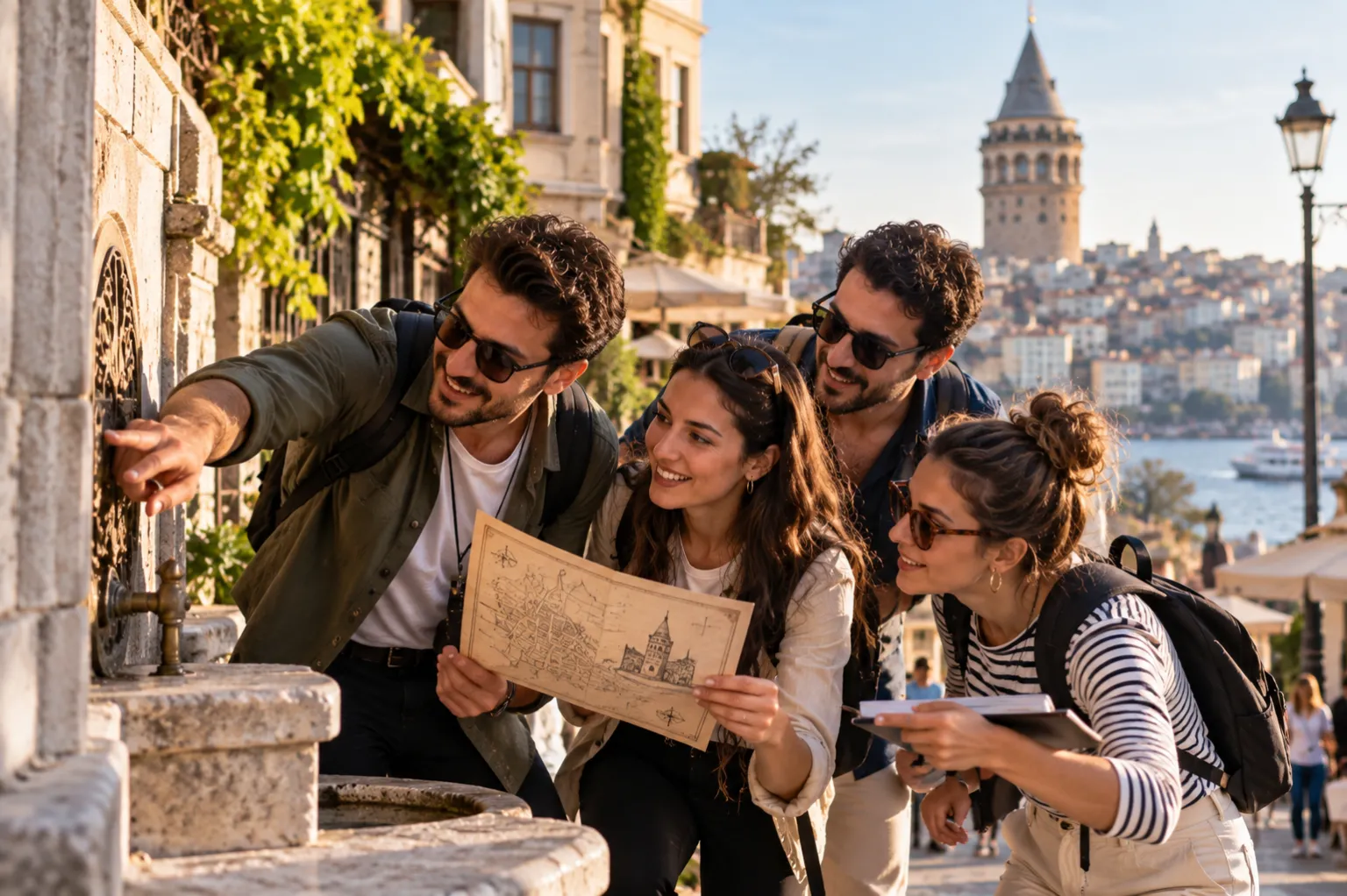
20 treasure hunt challenges for adult teams: photo tasks, riddles, local food, history and team coordination, plus design principles, inclusion notes and how to balance a city game.
Short answer: A good treasure hunt for adults is more than a chain of “find the next spot” clues. It mixes photo tasks, riddles, local food, history and team coordination challenges so that people with very different strengths all have a moment to contribute. Below you will find 20 challenge ideas that work well in a city game, the design principles we use when we build a route, and notes on making the game inclusive so that everyone in the team can take part.
If you want to know what a corporate treasure hunt is, how the different formats compare and how scoring works, start with our article what is a corporate treasure hunt. We do not repeat those basics here; this piece goes straight to the challenges. For short games to play inside the office, our team-building games and activities article is a better fit.
Principles for designing challenges
A treasure hunt is only as good as its challenges. Before you pick ideas from the list, it helps to agree on a few principles, because they decide which ideas belong on your route and which do not.
- Every challenge should serve a skill. Observation, creativity, knowledge, communication or coordination. Spread these evenly along the route so that the same two people do not end up doing everything while the rest of the team watches.
- Reward quality, not speed. Most challenges should earn points for accuracy and creativity. A “first back wins” rule turns the afternoon into a walking race and rewards the fittest, not the best team.
- Make the place part of the game. In a city game the clue should belong to that street, that fountain or that bazaar. A riddle that could be solved anywhere wastes the setting you have travelled for.
- Build a difficulty curve. Keep the first two or three challenges easy so teams can warm up, make the middle of the route the hardest, and ease off towards the end so teams reach the finale on time.
- Test every challenge on site. A clue that looks perfect on paper can become impossible when a sign has been replaced or a shop has closed. Walk the route shortly before the event.
- Respect people and places. Any challenge involving local people depends on their consent. Rules for places of worship, private property and busy pedestrian areas belong in the opening briefing.
20 treasure hunt ideas for adults
The table lists challenges that adapt well to city games, by type and by what they exercise. You do not need all of them: for a route of eight to fifteen stations, choosing a few from each type is enough to give the game variety and rhythm.
| # | Challenge | Type | What it exercises |
|---|---|---|---|
| 1 | Find the view shown on an old postcard or engraving and photograph it from the same angle | Photo | Observation, orientation |
| 2 | The whole team freezes as a “statue” on a theme drawn from a card (for example, “our company values”) | Photo | Creativity, fun |
| 3 | Use a date on an inscription, sign or fountain to unlock the code for the next clue | Riddle | Observation, logic |
| 4 | Find a place described in a short rhyme with a double meaning | Riddle | Language, interpretation |
| 5 | Decode a message written with a letter shift or a symbol key | Riddle | Analytical thinking |
| 6 | Assemble a map whose pieces are held by different team members | Coordination | Sharing information |
| 7 | Learn the name and story of a local speciality from a shopkeeper and retell it in a 30-second video | Local food | Communication, curiosity |
| 8 | A blindfolded smell test of spices or teas at a staffed station | Local food | Sensory awareness |
| 9 | Order tea, coffee or simit for the team in Turkish, using a phrase card | Local food / language | Confidence, cultural contact |
| 10 | Work out when and why a building was built from its information panel | History | Research |
| 11 | Put five shuffled historical events in the right order using buildings along the route | History | Logic, dividing the work |
| 12 | Sketch a tile or carved pattern; a jury scores the likeness | Creative | Attention, patience |
| 13 | Silent challenge: complete the station puzzle without speaking | Coordination | Non-verbal communication |
| 14 | Estimate the number of steps on a stairway or studs on a door, then check | Observation | Estimating and verifying |
| 15 | Reach the next point using only a sketch map drawn by the team (no map apps) | Navigation | Planning |
| 16 | Find a product or craft made in the city and photograph it with the maker’s permission | Discovery | Communication |
| 17 | A short balance or throwing game at a station, such as ring toss | Physical mini-game | Coordination |
| 18 | Match three questions about your company’s products or history to local clues | Company knowledge | Company culture |
| 19 | The team writes its own clue and leaves it at the station for the next team | Reverse challenge | Creativity, empathy |
| 20 | Finale video: a 60-second “memory” clip of the team’s day | Finale | Storytelling |
Notes on each type of challenge
Photo challenges
Photo tasks produce the material you will show at the finale, and they give the creative people in the team a chance to lead. They work best when a jury awards the points, for example for the most creative shot or the best interpretation of a theme, rather than a simple “done or not done”. Write one rule into the brief from the start: strangers’ faces stay out of the frame unless they have agreed.
Riddles and codes
The answer to every riddle must be verifiable on the spot, otherwise teams end up arguing with the game master rather than with the puzzle. A useful trick for codes is to split the key between different stations. Teams then have to talk to each other to finish, which creates a welcome moment of cooperation between rival teams in the middle of a competitive game.
Local food challenges
Tasting challenges are among the most popular, and they need the most care. Keep alcohol out of the game entirely, collect allergies and dietary requirements in advance, and make tasting optional rather than compulsory. The points should come from the story the team brings back, not from whether someone ate something. For international teams, a food challenge is often the moment they remember most, because it gives them a reason to talk to people they would otherwise walk past.
History challenges
History questions should be solved by observation rather than memory. Instead of asking “in what year was this built?”, ask teams to use the information on site to work out whether the building came before or after another event on their card. Historic districts are rich ground for this kind of challenge; in Istanbul, see our page on corporate events in Sultanahmet and the Historic Peninsula.
Team coordination challenges
The split map, the silent challenge and the sketch-map navigation task are the ones that turn a treasure hunt from a sightseeing walk into genuine teamwork. They force the team to share information, agree a plan and trust each other’s roles. We recommend including at least three of them on every route, spaced out so that the team has to coordinate several times during the afternoon rather than once.
Inclusion: a game everyone can play
A treasure hunt is a team event, so the design should never leave someone on the sidelines. These are the points we check on every route:
- Mobility: offer a step-free alternative route, or station-based roles such as jury member, code-breaker or timekeeper that are just as central to the team’s score.
- Language: in international teams, give clues in two languages, and when a challenge requires the local language, print the phrase on the card.
- Introverts: make “talk to a stranger” challenges optional, with an observation alternative worth the same points.
- Food and faith: tasting is optional and alcohol-free; at places of worship, any challenge stays outside and quiet.
- Weather: plan shade and water points in the heat and indoor stations in case of rain.
- Pace: some people want to compete hard, others want to enjoy the city. Bonus challenges let competitive teams chase extra points without forcing everyone to rush.
Balancing a city route
When you build a route from the ideas above, a simple mix works well for a half-day game of eight to fifteen stations:
| Challenge type | Suggested share of the route | Why |
|---|---|---|
| Photo and creative | About a quarter | Produces finale material and involves creative people |
| Riddles and codes | About a quarter | Gives analytical people their moment |
| Local food and discovery | Two or three stations | Brings the city to life and creates the best stories |
| History and observation | Two or three stations | Anchors the game in the place |
| Team coordination | At least three stations | Makes it teamwork rather than a walk |
Adapting the ideas to different cities
The same 20 ideas take a different shape in each city. In Istanbul, ferry crossings, bazaars and the historic peninsula provide the material; in Izmir, the Kordon waterfront and the Kemeraltı bazaar; in Antalya, the narrow lanes of Kaleiçi. For ready-designed city programmes, see our Istanbul, Izmir and Antalya treasure hunt pages, and our corporate treasure hunt in Turkey page for all cities. Teams usually have five to eight people, and the whole group can range from 10 to 300.
Common mistakes: Treasure Hunt Ideas for Adults
- Making every challenge a riddle: two analytical people play while everyone else watches.
- Untested clues: a single unsolvable clue can lock the whole route.
- Too many stations: more than fifteen stops usually means tired teams arriving late at the finale.
- Skipping the finale: results, a photo show and a short debrief are what give the afternoon its meaning.
- Forgetting the rest of the day: a long walking game straight after a long flight or before a gala dinner needs a shorter route and more rest points.
If you would like us to turn these ideas into a route designed for your team and your city, take a look at our corporate treasure hunt programmes and send your numbers, city and dates through our quote request form. We reply within 24 hours with an itemised proposal.
Leave a Comment