
Flagship programme Strategy and planning Resource management Classroom for 30

Pit Wall: Strategy and Resource Management Training on a Racing Simulator

Teams become racing teams: they decide on a fixed budget, read the data, plan — and rebuild the plan when the race takes an unexpected turn.

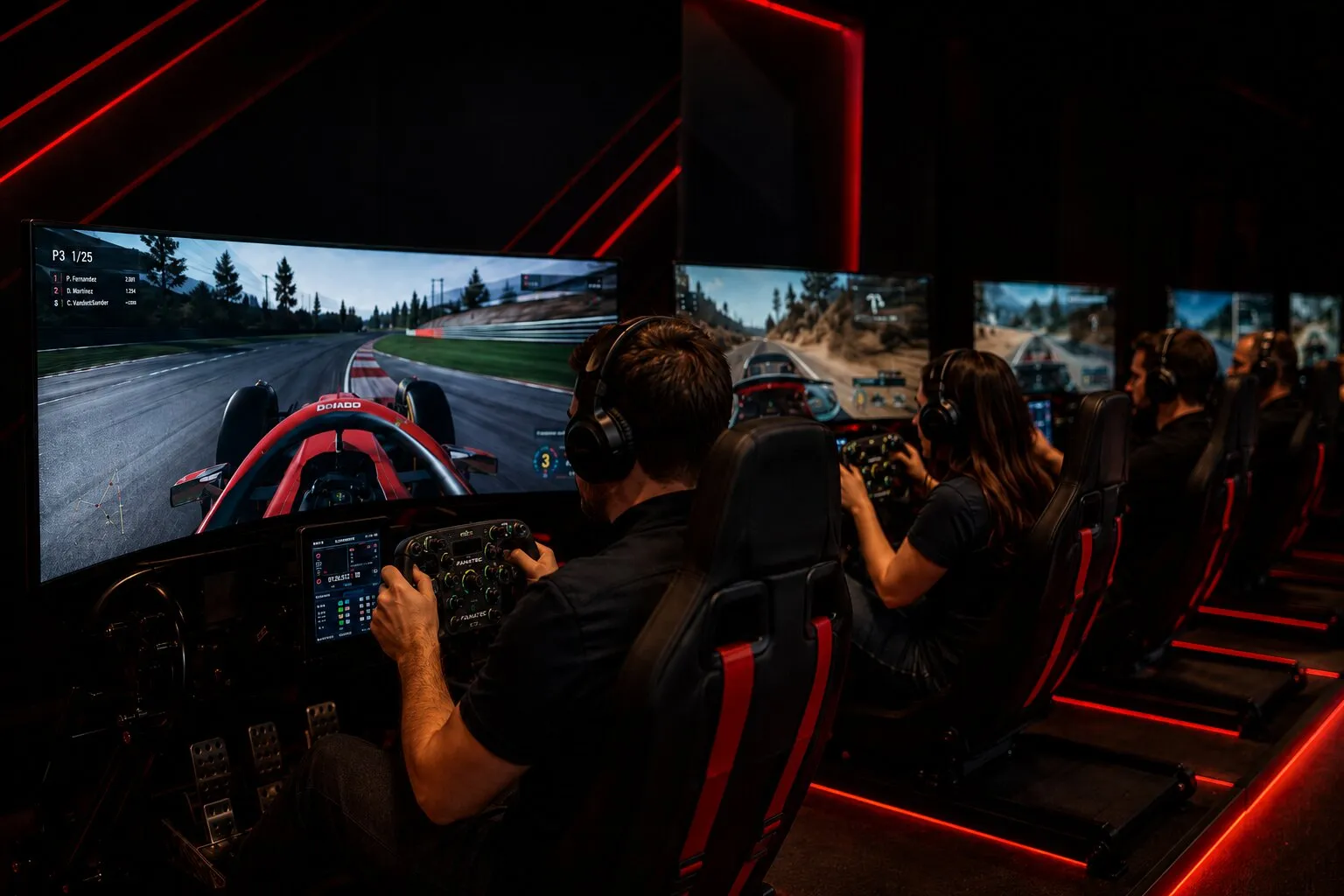
Pit Wall is our flagship programme that turns the racing simulator from an entertainment experience into strategy, planning and resource management training. Participants run a racing team in groups; the winner is not just the fastest driver but the team that uses its resources best and adapts best when the plan breaks. The programme runs with one facilitator and up to 30 people in a meeting room for 3–4 hours; our team handles the simulator set-up.

Quick Executive Takeaway
✓ TÜRSAB A-12558 Lisanslı

Pit Wall is our flagship programme that turns the racing simulator from an entertainment experience into strategy, planning and resource management training. Participants run a racing team in groups; the winner is not just the fastest driver but the team that uses its resources best and adapts best when the plan breaks. The programme runs with one facilitator and up to 30 people in a meeting room for 3–4 hours; our team handles the simulator set-up.

Last updated:

What is racing simulator strategy training like?

Short answer: Each group is a racing team with different roles and a limited budget. A plan is made before the race, unexpected things happen during it, and plan and actual are compared afterwards. The team making calls on the pit wall shapes the result as much as the person behind the wheel.

Why racing?

In motorsport, results depend on strategy, budget, data and team coordination as much as speed. That is very close to a company’s daily reality: resources are limited, competitors are moving, conditions change and waiting is rarely an option. The simulator recreates that reality in a safe, measurable setting.

What is learned?

  • Prioritising a limited budget by impact.
  • Collecting data before planning and deciding on it.
  • Clarifying roles: who decides, who executes, who reads the data?
  • Rebuilding the plan when something unexpected happens, without abandoning it.
  • Comparing plan and actual and taking the lesson back to work.

Who is it for?

Leadership teams, project and operations teams, sales and business development, teams preparing for annual planning. If you want the simulator purely as an event, see our F1 and rally simulation experience; to combine strategic thinking with other programmes, our strategic thinking and planning training is a good starting point.

Programme outcomes

01 Inclusion

Strategic thinking

Making today’s decision with the whole race in mind.

02 Inclusion

Resource management

Prioritising a limited budget by impact.

03 Inclusion

Planning

A written plan, its assumptions and a plan B.

04 Inclusion

Data-driven decisions

Deciding on collected data rather than instinct.

05 Inclusion

Team coordination

A team with clear roles and fast information flow.

06 Inclusion

Adapting in a crisis

Rebuilding the plan quickly when the unexpected happens.

Programmes for this competency

Each programme runs with one facilitator and a group of up to 30 in a meeting room, in 3–4 hours. The running order and materials are shared at proposal stage and adapted to your organisation.

Flagship programme Racing simulator

Pit Wall: Strategy on a Racing Simulator

Teams run a racing team on a fixed budget: they plan, read the data and rebuild the plan when the unexpected happens.

Strategic thinking Resource management and efficiency Planning and prioritisation Data-driven decision making Team coordination and role clarity Crisis management
Skill tests

Moneyball: Build a Squad on Data

Puts a gut-feel decision and a data-driven one side by side on the same field.

Data-driven decision making Resource management and efficiency Strategic thinking
Cycling

Peloton: Cooperating with Rivals

When to move together and when to break away: energy economy and temporary alliances.

Resource management and efficiency Strategic thinking Cross-department collaboration
Chess

Team Chess: Three Moves Ahead

Thinking several steps ahead as a team and reaching a shared decision.

Strategic thinking Planning and prioritisation Problem solving under uncertainty
Running

Negative Split: Marathon Pacing

Spreading energy and budget across a long project without burning out.

Planning and prioritisation Resource management and efficiency Stress management and resilience
Orienteering

Micro Orienteering: Route Optimisation

Choosing what to do, and in which order, when time is short.

Planning and prioritisation Resource management and efficiency
Orienteering

Missing Map: Orienteering in Uncertainty

Deciding when to move on incomplete information.

Problem solving under uncertainty Team coordination and role clarity Planning and prioritisation
Darts

Darts: Risk and Expected Value

Choosing between the risky and the safe option on your own data rather than gut feeling.

Data-driven decision making Risk management
Sailing

Read the Wind: Sailing Tactics Table

Redrawing the course as conditions change — indoors, in winter too.

Problem solving under uncertainty Change management and agility Strategic thinking

All competencies and programmes →

Measurement: what did the training change?

A short self-assessment on the chosen competencies is taken at the start and end of the programme. Team-level results are handed to HR in the closing report.

Prioritisation
Adapting to plan changes
Use of resources
Team coordination
BeforeAfter
Sample report view — not real client data.

Request the programme catalogue

We will send the catalogue — outcomes, suitable groups and a sample measurement report — to your corporate email address.

How the proposal takes shape

The proposal depends on the number of participants, simulators, venue and duration. The running order is shared at proposal stage.

01 Step

Group and goal

Number of participants, the team’s role and the competencies you want to emphasise.

02 Step

Venue and set-up

Your office, a hotel meeting room or a venue of your choice; the number of simulators is planned to fit the group.

03 Step

Scope and report

Facilitator, simulator set-up, materials and the measurement report are itemised; the proposal is sent within 24 hours.

Related programmes and experiences

The simulator experience and other programmes that complement strategy.

F1 & Rally Simulator Corporate Racing Experience

F1 & Rally Simulator Corporate Racing Experience

A corporate F1 and rally experience on professional simulators. High competition, team strategy and zero risk...

Problem Solving and Decision Making

Problem Solving and Decision Making

Structured decision work under time pressure: making measurable the balance between gathering information and...

Teamwork and Coordination

Teamwork and Coordination

A programme working role clarity and handover points: tasks requiring synchronisation that make visible where...

Frequently Asked Questions

Do participants need driving experience?
No. The driver role is voluntary and anyone can drive after a short practice; other team members take strategy, data and budget roles. The result depends on the team’s decisions, not just driving.
How many simulators are needed?
The number of simulators is planned around group size and duration. Drivers take turns; the rest of the team plans and analyses in the meantime.
How long is it and for how many people?
3–4 hours in a meeting room; the standard group is one facilitator and up to 30 people. Larger groups run parallel races.
Where can it be run?
An office, a hotel meeting room or any indoor space with power and enough room. Our team handles set-up and take-down.
How does it differ from the F1 simulation experience?
The experience event is about fun and competition. Pit Wall is a training programme: it includes roles, a budget, planning and a debrief, and closes with a measurement report.
How is the impact measured?
A short self-assessment on prioritisation, use of resources, adapting to plan changes and coordination is taken at the start and end; team-level results are reported to HR.
Interactive Planning Tool

Build Your Company’s 3, 6 or 12-Month Sports Calendar

Interactively select team size, starting month, and focal disciplines (tournaments, wellness, water sports, outdoor retreats). Get an instant date-spread proposal draft sent directly to your inbox.

✓ 1, 3, 6 and 12-Month Options
✓ Balanced Sports & Wellness Mix
✓ Free Email Proposal Draft
Corporate Event Calendar
3-6 AY
1. DÖNEM
Bosphorus Rowing & Team Icebreaker
Social engagement & team coordination
2. DÖNEM
Company Football / Padel League
6-week regular fixture & standings
3. DÖNEM
Sapanca Nature & Wellness Camp
Dragon boat, yoga & grand trophy final

Get a tailored proposal within 24 hours

Share your headcount and approximate date; we will come back with the format and budget range that fit, within the same business day.

Get a Free Quote