
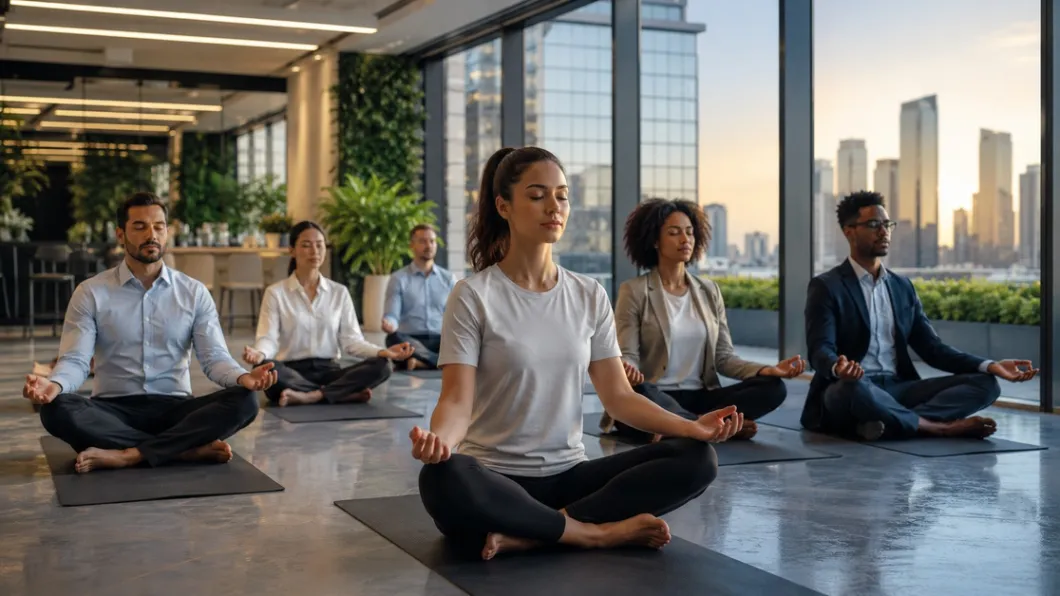
Corporate wellness trends for 2027: why yoga is still at the core, movement breaks, mental wellbeing, hybrid access, personalised menus, the manager's role and a practical guide to measurable programmes.
Short answer: In 2027 corporate wellness is moving from individual events to regular, personalisable and measurable programmes. Yoga stays at the core because it needs little equipment or space and suits every age and fitness level; around it, companies are adding short movement breaks spread through the day, workshops on mental wellbeing and sleep, online access for hybrid staff and measurement methods that track participation over time.
This article expands, for 2027, the piece we published for 2026 on why yoga tops the list. We keep yoga at the centre but look at the whole picture: which trends are gaining ground, how HR teams should build a programme and how to report results. What follows reflects requests we hear frequently in planning conversations and general observation; it is not a statistical study.
Corporate wellness trends for 2027 at a glance
| Trend | What it means in practice | First step |
|---|---|---|
| Yoga at the core | A fixed weekly session plus short desk-based practice | An 8 to 12-week weekly yoga hour |
| Movement breaks | 5 to 15-minute stretching and movement spread through the day | Adding breaks to long meetings |
| Mental wellbeing | Workshops on stress, sleep and focus | A stress-management series starting with managers |
| Hybrid access | Office and online sessions planned together | A live stream or recording for every session |
| Personalised menu | Optional modules instead of one programme for all | A short preference survey |
| Social wellness | Running clubs, walking groups, a company sports club | Appointing a volunteer club captain |
| Measurability | Participation, retention and pulse-survey trends | A baseline survey repeated each quarter |
| The manager's role | Managers taking part and protecting time | A dedicated session for the leadership team |
1. Why yoga is still at the core
The reasons yoga has lasted in corporate programmes have not changed; if anything, they have strengthened:
- Minimal setup: an instructor, mats and an empty meeting room are enough. You can start in the office without hiring a venue.
- Suitable for every level: with the right instructor, someone who has never exercised and someone who trains regularly can work at their own level in the same class.
- Body and mind together: because it combines flexibility and posture with breathing and attention, it addresses both physical and mental wellbeing.
- Flexible format: it adapts from a 10-minute desk routine to a 60-minute class, from the office to the outdoors, from retreats to online sessions.
In 2027 yoga shows up in two main forms: a fixed weekly yoga hour and short desk yoga breaks spread through the day. For more on how yoga breaks relate to performance, see our article on yoga breaks at work.
2. Movement breaks: small but regular
Fatigue and tension from long hours of sitting are among the most common complaints from desk-based teams. In 2027 programmes, this is tackled not with big events but with short movement breaks spread through the day:
- Adding a 5 to 10-minute stretch break to meetings longer than an hour
- A short team movement routine during the mid-afternoon dip
- Two or three minutes of breathing and neck-and-shoulder exercises at the start of online meetings
- Walking one-to-ones
To add instructor-led movement to meeting breaks, see our meeting sports break format. Short, regular breaks often leave more of an impression than one long monthly event.
3. Mental wellbeing: stress, sleep and focus
Wellness programmes increasingly focus on mental wellbeing. Workshops on stress management, sleep habits, digital fatigue and focus now sit alongside physical activity in the same programme. Two principles matter here: content should be delivered by qualified experts, and a wellness programme must not replace psychological support services; there should always be a clear route to professional help for employees who need it. Starting with leadership teams shows that the message is owned from the top; our yoga and stress management for managers programme is a good entry point.
4. Hybrid access: the same programme in the office and at home
In hybrid companies, office-only sessions reach only part of the workforce. The approach spreading in 2027 is to schedule office sessions on days when teams are in, and to open the same sessions to remote staff via live stream or recording. Office yoga also creates a positive reason to come in; "there's yoga in the office on Tuesdays" lands better than a mandatory office day.
5. A personalised menu, not one programme for all
Every team has people who want yoga, people who want a running club and people who only want a desk stretch. Offering one programme to everyone lowers participation. The structure gaining ground in 2027 combines a core component, such as weekly yoga, with optional modules such as Pilates, functional training, a running group or a stress workshop. A short annual preference survey is the easiest way to keep the menu current.
6. Social wellness: moving together
Social connection is part of wellbeing too. Running clubs, lunchtime walking groups and company sports clubs turn regular movement into a way of building bonds within and across teams. A volunteer captain, a fixed day and time and a low barrier to entry keep these structures going.
7. Measurable programmes
A wellness budget has to show results like any other HR investment. Measurement need not be complicated; this simple framework is enough for most companies:
- Baseline survey: a short 6 to 8-question survey on energy, perceived stress, movement habits and expectations before the programme starts.
- Participation and retention: attendance per session and the share of employees who attend at least four sessions.
- Session feedback: a one-question satisfaction check at the end of each module.
- Quarterly repeat: repeating the baseline survey with the same questions every three months and tracking the trend.
- Report to leadership: a simple one-pager combining participation, trends and employee comments.
Avoid collecting personal health data; keep surveys anonymous and report results in aggregate. For a more detailed method, see our article on measuring the return on corporate sports events.
8. The manager's role
Even the best-designed wellness programme fails if managers schedule meetings over sessions. Whether managers attend, give their teams time and make movement breaks part of meeting culture directly determines success. Launching the programme with a dedicated session for the leadership team and asking managers to protect wellness slots in team calendars is a simple but effective step.
Adapting to different employee groups
Wellness programmes are often designed around desk-based staff at headquarters and miss other groups. 2027 plans pay more attention to these distinctions:
- Field and retail teams: for people who work on their feet and on the move, short stretching and recovery sessions close to the start of a shift work better.
- Production and shift teams: repeating sessions at two times to suit different shifts, and running them on site, determines participation.
- Different ages and fitness levels: instructors who offer level options within the same session ensure no one feels inadequate.
- Offices in other cities: setting up the same programme with local instructors offers a fairer experience than streaming sessions from headquarters.
Common mistakes
- Stopping at the launch: a big opening day without regular sessions afterwards means the programme is forgotten within weeks.
- Pushing it outside working hours: evening sessions can undermine work-life balance rather than support it.
- One-size-fits-all: assuming everyone wants the same thing lowers participation in the first month.
- Renewing without measuring: a programme with no baseline data cannot defend its budget at year-end.
- Neglecting privacy: surveys asking for personal health information damage employees' trust.
Sample annual wellness calendar
| Period | Core | Additional module |
|---|---|---|
| January–March | Weekly yoga hour | Sleep and stress workshop, desk movement breaks |
| April–June | Weekly yoga hour | Outdoor walking or running group |
| July–September | Lighter schedule, online sessions | Outdoor yoga, summer event |
| October–December | Weekly yoga hour | Pilates or functional training, year-end review |
Starting with a pilot
Rather than moving straight to an annual wellness programme, starting with an 8 to 12-week pilot makes budget approval easier and clarifies what is actually needed. Choose one or two teams, use a weekly yoga hour as the core component and add a single extra module, such as movement breaks or a stress workshop. Run the baseline survey before the pilot, track attendance weekly and repeat the survey in the final week. At the end, look for answers to three questions: which sessions did people attend regularly, which times worked, and what needs to change before scaling up? The answers determine the scope of the annual programme, session frequency and which offices to prioritise. Pilot data is also the strongest basis for the budget request you take to leadership.
Checklist
- The programme's goal and audience are written down.
- The core component (such as weekly yoga) and optional modules are defined.
- Session times fit office days and shifts.
- Online access or recordings are available.
- A baseline survey and quarterly measurement plan are ready.
- The leadership team is involved.
- Headcount, locations, session frequency and duration are clear for a quote.
Conclusion
In 2027 corporate wellness is becoming a structure that keeps yoga at its core while expanding into movement breaks, mental wellbeing, hybrid access and measurement. Lasting impact comes not from a big launch but from a regular, accessible and tracked programme. If you would like to design an annual programme for your team, see our corporate wellness programmes page and share your headcount and locations through our quote form.


Leave a Comment