
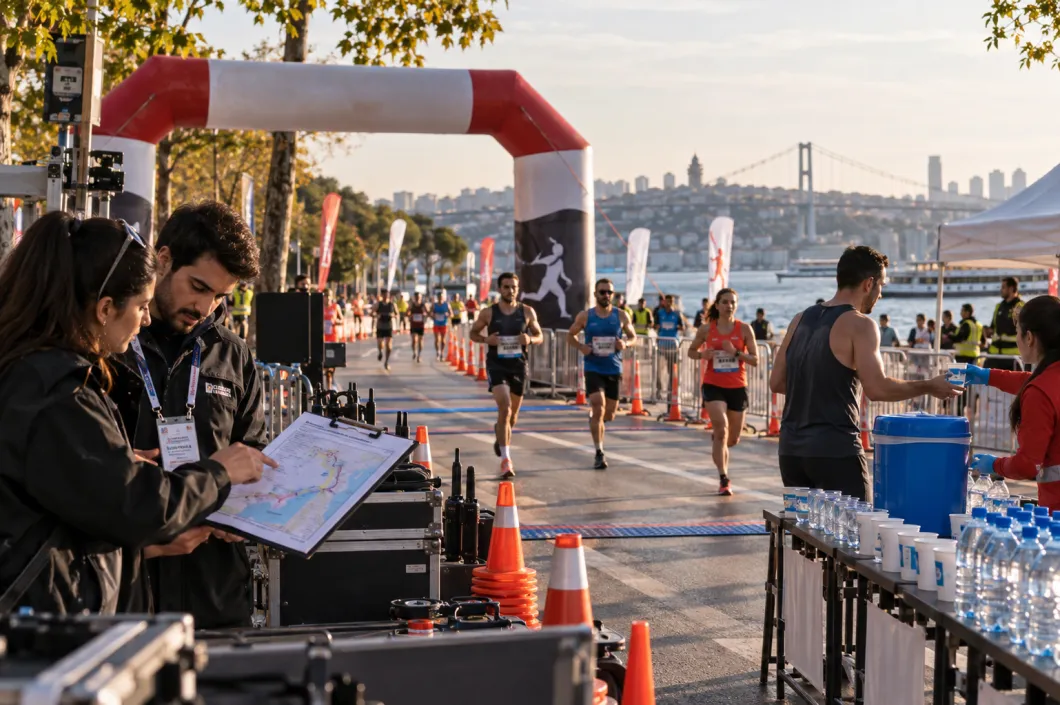
Organising a public run or marathon as a municipality, public body or brand? Choosing the format and distance, course principles, permits, registration, timing, medical planning, volunteers and a 16-week plan.
Short answer: To organise a public run or marathon, you first choose the format, distance and date; then you design and measure the course, set up a timeline for the permits required by the relevant authorities, open registration and write the timing, medical, safety and volunteer plans. At least 12 weeks of preparation is recommended for a public run and 16 weeks or more for a half marathon or marathon. Because permit requirements vary from city to city, the first job is to clarify early what the institution and the relevant authorities expect.
This guide is written for teams organising a public race on behalf of a municipality, public institution or brand. The steps below apply both to a 5 km family run and to a multi-category marathon; the difference lies in the scale of each step. If you would like to see the lines and scope of the organisation directly, see our marathon and running event organisation page.
1. How do you choose the purpose, format and distance?
Everything starts with the question “what is this race for?”. For a municipality the purpose may be getting residents moving and promoting the city; for a university, the campus community; for a brand, visibility and community ties. The purpose sets the format:
If the goal is broad participation: a 5 km public run or fun run, with a children’s race alongside.
If the goal is a competitive race: a 10 km race, half marathon or marathon, with chip timing and category prizes.
If you want both: two or three categories on the same day; separate starts cater for racers and families alike.
If it is brand- or theme-led: a night run, colour run or themed run, where fun and experience areas come first.
As the distance grows, it is not only the course that gets longer: road closure time, the number of water and medical points, staffing needs and the scope of permits all grow with it. For institutions organising a race for the first time, starting with a short distance and adding categories in later years is a more manageable path.
2. How do you set the date and season?
In Turkey, spring and autumn are usually the most suitable seasons for running; summer heat and winter rain and short daylight make planning harder. When choosing a date, check:
Clashes with other major events, matches and official ceremonies in the city
Other races in the same region at the same time (the pool of runners gets split)
School holidays and public holidays (which can raise or lower family turnout)
The expected temperature at the morning start; late-summer races start as early as possible
Commemorative and national holiday runs have fixed dates, so permit applications and procurement need to start earlier. For weather-related postponement and cancellation scenarios, the decision criteria in our event risk plan article can be adapted to races.
3. How do you design a race course?
A good course works smoothly for both runners and the city. The core principles:
An accurately measured distance: The course must deliver exactly the advertised distance; it is measured along the shortest line runners will take.
Few junctions and crossings: Every closed junction means extra marshals and traffic load. Loop or out-and-back courses can reduce the need for closures.
A safe surface: Tram tracks, sunken drain covers, steep descents and narrow bridges are either marked or taken off the route.
The start–finish area: A square or park close to public transport, with room for kit collection, bag drop, toilets and a medical area.
Ambulance access: There must be a road by which a medical vehicle can reach every point of the course.
The spectator experience: Points where spectators can watch safely turn the race into an event for the whole city.
4. Which permits does a running event need?
Running event permits vary with the city, the route and the scale of the event, so no single list applies everywhere. In general, the relevant authorities involved in the process are:
The municipality: use of public space, allocation of squares and parks, set-up and cleaning.
Police and traffic units: road closures, traffic management and the security plan.
Civil administration such as the governorship or district governorship: approvals required according to the scale and location of the event.
Other bodies: the relevant administrations if the route crosses highways, the seafront, forest land or private property.
Permits and official approvals rest with the institution and the relevant authorities. The organiser’s role is to draw up the list and timeline of applications, help prepare the documents required (such as the course map, traffic plan, and medical and safety plan) and follow the process through. A practical tip: at the first meeting, ask each relevant unit “which document, by when, to whom” and record the answers in a single tracking sheet.
5. Registration model: paid, free or charity?
| Model | Advantage | What to watch |
|---|---|---|
| Free registration | Lowers the barrier to entry and suits a public event | No-shows can rise; plan kit and T-shirt numbers cautiously |
| Paid registration | Covers part of the kit and timing costs; sign-ups are firmer | The institution’s regulations and payment method must be clear from the start |
| Charity model | Gives the event a social purpose | Announce transparently which organisation receives the donations and how |
Whichever model you choose, the registration form should include category, T-shirt size, an emergency contact and a health declaration; the privacy notice and consent wording on personal data should be prepared with the institution’s legal team.
6. Timing and results
In competitive categories, chip timing linked to the bib number and live results are expected. The timing plan covers start and finish readers, split points where needed, category rankings and how results will be published. For fun-focused public runs, simpler timing may be enough. The time of the award ceremony is set by taking into account the last category’s finish and the checking of results.
7. The medical and safety plan
Medical cover and safety are lines that should not be cut from the budget. The plan covers:
Medical points along the course and a medical area at the finish
Ambulance positioning and a hospital referral plan
Spacing of water and aid stations; extra water and cooling in hot weather
Course marshals at junctions and barriered funnels
A cut-off time and a sweep vehicle following the back of the field
A single communication chain for lost children, lost property and emergency announcements
Specialist lines such as timing and the medical team are delivered with specialist crews and partners; what matters for the institution is that every line sits under one coordination. For liability and insurance, our contract, insurance and liability checklist is a good starting point.
8. Volunteers and marshals
Volunteers are the face of the race: kit collection, water stations, junctions, the finish and the medal area all run on them. Recruit volunteers early, give each one a single clear task, hold a short briefing a few days before the race and assign a lead to each zone. University societies, sports clubs and municipal youth units are good sources of volunteers.
9. Sponsorship
Sponsorship can be a significant part of the budget, especially with free registration. Typical sponsorship items are naming rights, logos on kits and medals, visibility in the start–finish area, water station sponsorship and an experience stand. Putting in writing from the start what the sponsor receives (visibility areas, photos, a participation report) also makes the relationship easier in later years. Combining the race with a sports festival increases sponsor visibility; see our sports festival organisation page for that.
10. Accessibility: children and disabled participants
A public race succeeds to the extent that everyone can take part. For a children’s race, plan short, closed courses by age group, separate starts and a parent pick-up area. For wheelchair users and visually impaired runners (with their guide runners), consider a separate category or start wave, accessible toilets and ramps, and gradient and surface checks along the course. Opening these categories on the registration form from the outset shows that you take participation seriously.
11. The 16-week plan
| When | Main tasks |
|---|---|
| T-16 weeks | Purpose, format, distance, date; draft route; budget and procurement model |
| T-12 weeks | Course measurement; permit application timeline; sponsor talks; registration page |
| T-8 weeks | Registration opens and announcements; traffic, medical and timing plans; kit order |
| T-4 weeks | Volunteer recruitment and briefing plan; aid station layout; information for local residents |
| T-1 week | Registration closes; bib–chip pairing; kit collection; final coordination and weather check |
| T+1 | Final results, thank-you email, photos, closing report |
12. Race-day schedule (example)
The schedule below is for a morning 10 km + 5 km public run; times are adjusted to the course and permits.
| Time | Task | Responsible |
|---|---|---|
| 05:30 | Set-up crew on site; start–finish, barrier and stage checks | Organising team |
| 06:30 | Road closures begin; aid stations and medical points take position | Relevant units, medical team |
| 07:00 | Volunteer briefing; bag drop and information desk open | Volunteer coordinator |
| 07:45 | Warm-up and announcements | Host, instructor |
| 08:00 | 10 km start | Start lead, timing |
| 08:15 | 5 km start | Start lead |
| 09:30 | Cut-off; the sweep vehicle closes the course | Course lead |
| 10:00 | Award ceremony | Protocol, host |
| 10:30 | Dismantling and phased reopening of roads | Organising team, relevant units |
13. What happens after the race?
Publish the final results, send participants a thank-you email with a link to the photos and measure the experience with a short survey. For the institution and sponsors, prepare a closing report covering participation, the split between categories, feedback and improvements for next year; our post-event report template can be adapted for this. Turning a race into an annual tradition usually depends on taking the lessons of the first year into early planning for the second.
Let’s plan your race together
Kurumsal Sporlar is an Istanbul-based organiser that has been running sports events since 2015 and works across all 81 provinces of Turkey. For municipal, institutional and brand races, we deliver every line under a single contract, from course design to timing and from the medical and safety plan to the award ceremony; institutions can work with us through a tender, direct procurement or a sponsored model. You can find the scope and the information we need for a quote on our marathon and running event organisation page, and other public-sector formats on our municipal and public sports events page. If you would like to prepare your own employees for the race, we also run a company running club programme.

Leave a Comment