
A sports festival guide for municipalities and public bodies: goals and audience, date and venue, zone plan, stations, staffing, safety, accessibility, permits, procurement routes and a checklist you can paste into a scope document.
Short answer: To organise a municipal sports festival, first pin down the goal and the audience, then choose the date and venue, divide the site into zones (sports areas, children’s area, obstacle course, experience stations, stage, medical, registration, refreshments, toilets) and prepare equipment, staffing and a safety plan for each zone. Permits sit with the institution and the relevant authorities, and procurement follows the route the institution chooses (a public tender, direct procurement or a sponsored model). A scope document that itemises every line makes it easier both to compare quotes and to run the festival on the day.
This guide sets out the steps a municipality, governorate, university or provincial sports directorate can follow when planning a public sports festival. At the end there is a checklist table you can paste straight into your scope document. If you are thinking of running the festival end to end with an organiser, the full scope is on our sports festival organisation page.
1. Goal and audience: who is the festival for?
Even two festivals held on the same site on the same day can serve different goals. Writing the goal down makes every later decision (site, stations, timing, announcements) easier.
Public health and activity: Giving citizens of all ages a chance to try a sport; taking part matters more than competing.
Youth: A youth and sports festival or a street sports festival, built around 3x3 basketball, obstacle courses, esports and music.
Families and neighbourhoods: A weekend community day with a children’s area, family games, a picnic and a stage programme.
Commemoration and celebration: 19 May or public holiday programmes, with sports areas that open after the ceremony.
Promotion: Introducing a new park, seafront or sports facility to the public.
When defining the audience, estimate the age range, the expected number of participants and how that number will spread through the day. At a public festival the exact figure is never known, but observations from past events, the site’s capacity and the promotion plan give a reasonable range. That range sets the scale of everything from the number of stations to the number of water points.
2. How do you choose the date and venue?
When choosing the date, weigh up the school calendar, public holidays, other events in the district and the season. In summer, the hottest hours are the weakest part of the programme; spring and autumn are usually more comfortable for outdoor festivals. Either way, setting an alternative date saves time if the weather or a permit forces a postponement.
When choosing the venue, ask:
Is the ground level and well drained? Is it grass, asphalt or sand?
Is it easy to reach by public transport and on foot? How will parking be handled?
Can set-up vehicles get onto the site, and where is the loading point?
Are there existing power, water and toilet facilities?
Can a separate access route be kept for ambulances and emergency vehicles?
Is there enough shade, or will tents and gazebos be needed?
How will nearby homes, roads and businesses be affected?
3. The zone plan: dividing the site into areas
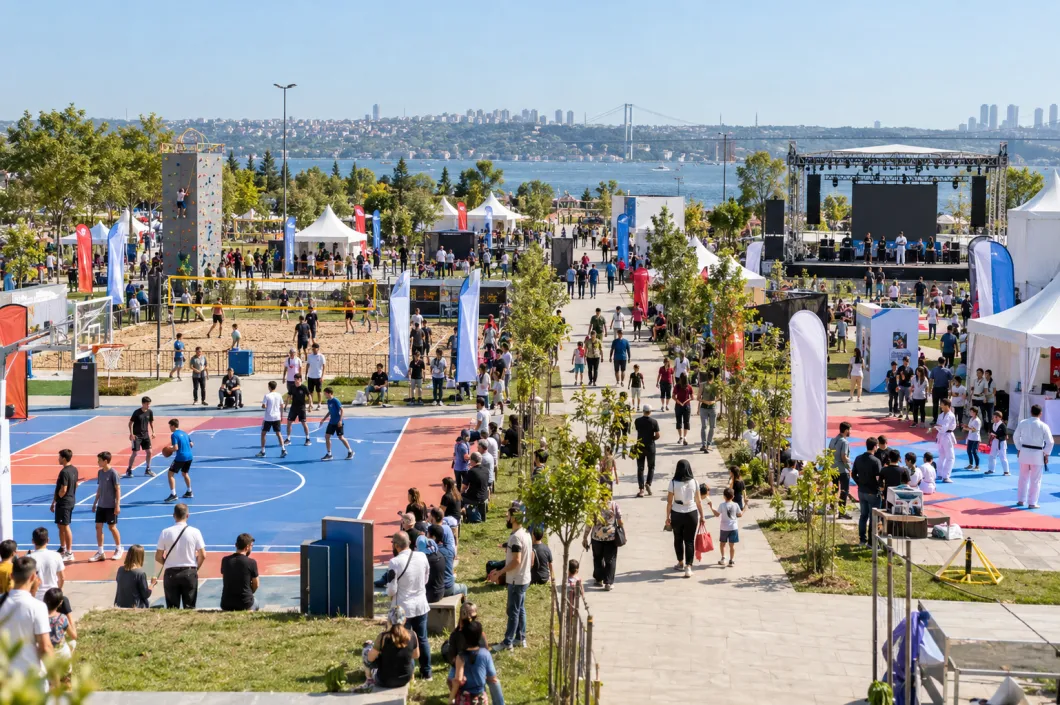
The zone plan is the festival’s map. Each zone serves one purpose and lets visitors move around without getting lost or stuck in queues. A typical municipal sports festival has these zones:
Sports areas: Portable football, volleyball and basketball courts; mini tournaments.
Children’s area: A fenced children’s course and play stations, split by age group.
Obstacle area: An obstacle course or adventure course equipment.
Experience stations: Archery, VR and simulator stations.
Stage: Opening, demonstrations, awards and announcements.
Medical point, information and registration, refreshments, toilets and utilities: In places visitors can find easily, close to the emergency access route.
When placing zones, keep noisy areas (the stage) away from quiet ones (the children’s area and medical point), close off the area behind stations with a shooting line such as archery, and leave a queuing area in front of the busiest stations. We describe the physical set-up of portable courts, courses, tents and generators in detail on our sports event area and course set-up page.
4. Which stations should you choose?
Stations are chosen to suit the audience and the site. A good mix gives every visitor, whatever their age or fitness, at least one option:
Team sports: 3x3 basketball, volleyball, small-sided football, dodgeball; short matches in fixtures that run all day.
Skill stations: Archery, target throwing, balance and coordination stations.
Courses: An obstacle course for adults and young people, a children’s course for younger ones.
Experience and digital stations: VR stands and simulators that need no fitness and suit every age.
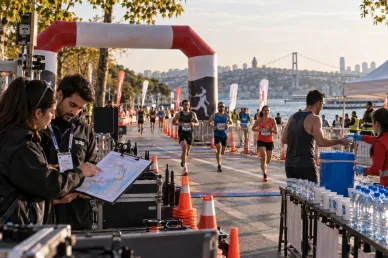
Running and walking: If you want to open or close the festival with a public run, the course, timing and safety are planned separately; see our article on how to organise a public fun run.
One rule helps when setting the number of stations: short, repeatable stations keep waiting times down. Stations that take a long time and serve few people at once create queues and frustration at public festivals.
5. Staffing: who does what, and where?
At a public festival, every station needs someone who explains the rules and keeps an eye on safety. A typical team looks like this:
Sports coaches: Warm-ups, rules and match management in the sports areas.
Entertainers: The children’s area and family stations.
Host: Stage running order, announcements, results and lost-child announcements.
Zone leads: Queues, equipment and visitor guidance in each zone.
Site coordinator: The institution’s single point of contact, in touch with every team.
Volunteers: The municipality’s youth centres or volunteer network; role descriptions and a briefing are essential.
Staff numbers are worked out from the number of stations, participant numbers and festival length. The scope document should state clearly who covers each role: the institution or the organiser.
6. Safety and crowd management
The safety plan should be written down before the festival and shared with every team. The core headings are:
Entry, exit and emergency corridor: The ambulance route stays clear all day, and barriers are placed accordingly.
Circulation: One-way circulation where possible, queuing areas in front of busy stations and no bottlenecks between zones.
Medical cover: A first-aid point and, where needed, an ambulance, in a location everyone knows and can reach easily.
Child safety: A fenced children’s area, name and contact wristbands, and a lost-child and meeting point procedure.
Weather: Shade, water points and a lighter programme in the hottest hours; stations to close in wind or rain. The approach in our event risk plan article for weather and cancellation scenarios can be adapted to public festivals.
Communication: A single channel between teams and a clear decision on who calls the shots if something happens.
7. Accessibility: can everyone take part?
A public festival is for everyone, so accessibility should be planned as a heading of its own:
Walkways and ramps that work for wheelchairs and pushchairs
Accessible toilets and rest areas
Stations that people with limited mobility can also try (for example VR experiences that can be played seated, or adapted archery)
Clear wayfinding signs and a visual equivalent for announcements made from the stage
A quiet break area away from the crowd
8. Permits: who follows up on what?
Permits and official approvals for use of the site, any traffic arrangements, stage and sound, and medical and security coordination are the responsibility of the institution and the relevant authorities. Which permits are needed depends on the site, the length of the festival and its content. The organiser’s role is to support and follow the process by preparing documents such as the layout plan, equipment list, set-up schedule and safety plan. Permit processes are often the longest item in the timeline, so they should start at the very beginning of planning.
9. Procurement routes: tender, direct procurement, sponsored model
Public bodies buy services according to their own regulations and decisions. Broadly, three routes are common:
Public tender: The institution opens a tender, setting out the scope and terms, and bidders submit offers. A scope document that defines every line makes the bids comparable.
Direct procurement: Where the regulations allow, the institution collects quotes and buys without opening a tender. Here too, a clear scope makes the differences between quotes visible.
Sponsored model: Part or all of the festival is backed by a brand, with brand visibility planned within the institution’s rules.
Which route is chosen and which documents are requested is the institution’s decision. What matters from the organiser’s side is that the scope, responsibilities and lines are written down clearly. We describe how we work with public bodies on our municipal and public-sector sports events page.
10. A checklist for your scope document
The table below can be added straight to your scope or request-for-quote document. Each row holds a question bidders should answer; the answers let you compare quotes on the same basis.
| Item | Check question |
|---|---|
| Goal and audience | Are the festival’s goal, age profile and expected participant range written down? |
| Date and time | Are the festival date, an alternative date, opening hours and the time allowed for set-up and strike stated? |
| Site | Are the address, approximate dimensions, surface type, vehicle access and existing utilities described? |
| Zone plan | Does the bidder provide a draft plan showing the layout of zones? |
| Stations | Are each station’s content, equipment and how many people it can serve at once written down? |
| Staffing | Are the numbers and role descriptions of coaches, entertainers, host, zone leads and coordinator stated? |
| Stage and technical | Are the stage size, sound and lighting scope, host and technical crew defined? |
| Infrastructure | Is it written separately who provides tents, gazebos, generators, barriers, toilets and water points? |
| Medical | Are the first-aid point and ambulance needs, who provides them and their location stated? |
| Safety | Are crowd flow, the emergency corridor, the lost-child procedure and private security scope defined? |
| Accessibility | What is planned for accessible routes, toilets and stations? |
| Weather plan | Are heat, wind and rain scenarios and the conditions for postponement written down? |
| Branding | Are institution and sponsor visibility, sign and banner quantities and the design approval process stated? |
| Set-up and strike | Are the set-up and strike schedule, site handover conditions and cleaning responsibility defined? |
| Reporting | Is a post-festival report with photos and video included in the scope? |
| Pricing format | Does the quote show every line separately, with the currency and validity period stated? |
11. Evaluation after the festival
The work does not end when the festival does; measuring is how the next one gets better. The evaluation can look at:
Participation observations: Which stations had queues and which stayed empty? At what times of day did numbers peak?
Visitor feedback: A short survey on site or afterwards; a few questions are enough.
Incident records: Visits to the medical point, lost-child cases, equipment faults and the action taken.
Team review: Short notes from zone leads on what worked and what should change.
Visual archive: Photos and videos for the institution’s communication channels and next year’s announcement.
Turning this into a one-page report gives you both a presentation for management and a solid starting point for next year’s scope document. For the report structure, you can adapt our post-event report template.
Municipal sports festivals with Kurumsal Sporlar
We have been running sports events from our Istanbul base since 2015, across more than 50 sports and in all 81 provinces of Türkiye. We can bid in tenders that municipalities and public bodies open through EKAP, submit quotes for purchases made through direct procurement, and run sponsored festivals. The scope is set by participant numbers and the site, and an itemised quote arrives within 24 hours in TRY, USD or EUR. You can explore festival types, the zone plan and staffing on our sports festival organisation page.

Leave a Comment