
How do a 25-year-old runner and a 55-year-old who never exercises share the same event? Inclusive format choices and design principles.
The most real constraint in corporate event planning is not budget but the diversity of the team. The same list contains a 28-year-old developer who runs three times a week and a 54-year-old finance manager who does not exercise at all. Both should come, and both should feel good at the end of the day.
This is solved not by format choice but by design principles.
The wrong solution: aiming for the average
The most common mistake is pitching difficulty in the middle. The result: the fit are bored and those who struggle still struggle. The average is a level that suits nobody.
The right approach is to build formats that let participants choose their own difficulty.
Five design principles for an inclusive event
1. Every station needs an easier alternative
In the corporate version of an obstacle race, every obstacle has an alternative and a "right to skip". That single rule turns the format from a fitness test into a team game.
2. Score on completion, not individual time
When the team score is based on "did the team finish together" rather than "who finished fastest", a slower participant does not hold the team back — on the contrary, the team getting them through earns points.
3. Put skill ahead of strength
In activities requiring aim, balance, strategy and coordination, the advantage of youth and fitness shrinks. Archery, darts, boules, curling, table tennis and escape rooms fall into this category.
4. Create a variety of roles
Formats where not everyone has to do the same thing are the most inclusive. In sailing: helm, trimmer, lookout. On a course: running, carrying, directing. In a tournament: playing, scoring, photographing.
5. Make not participating a dignified option
"Anyone who prefers not to can rest" is not enough — it leaves that person outside. The alternative programme needs value of its own: a nature walk, a photography role, responsibility for the scoreboard, a conversation area.
Formats that work best for mixed groups
| Format | Why it is inclusive |
|---|---|
| Padel / pickleball | Very low learning barrier; in pickleball the kitchen rule limits physical advantage |
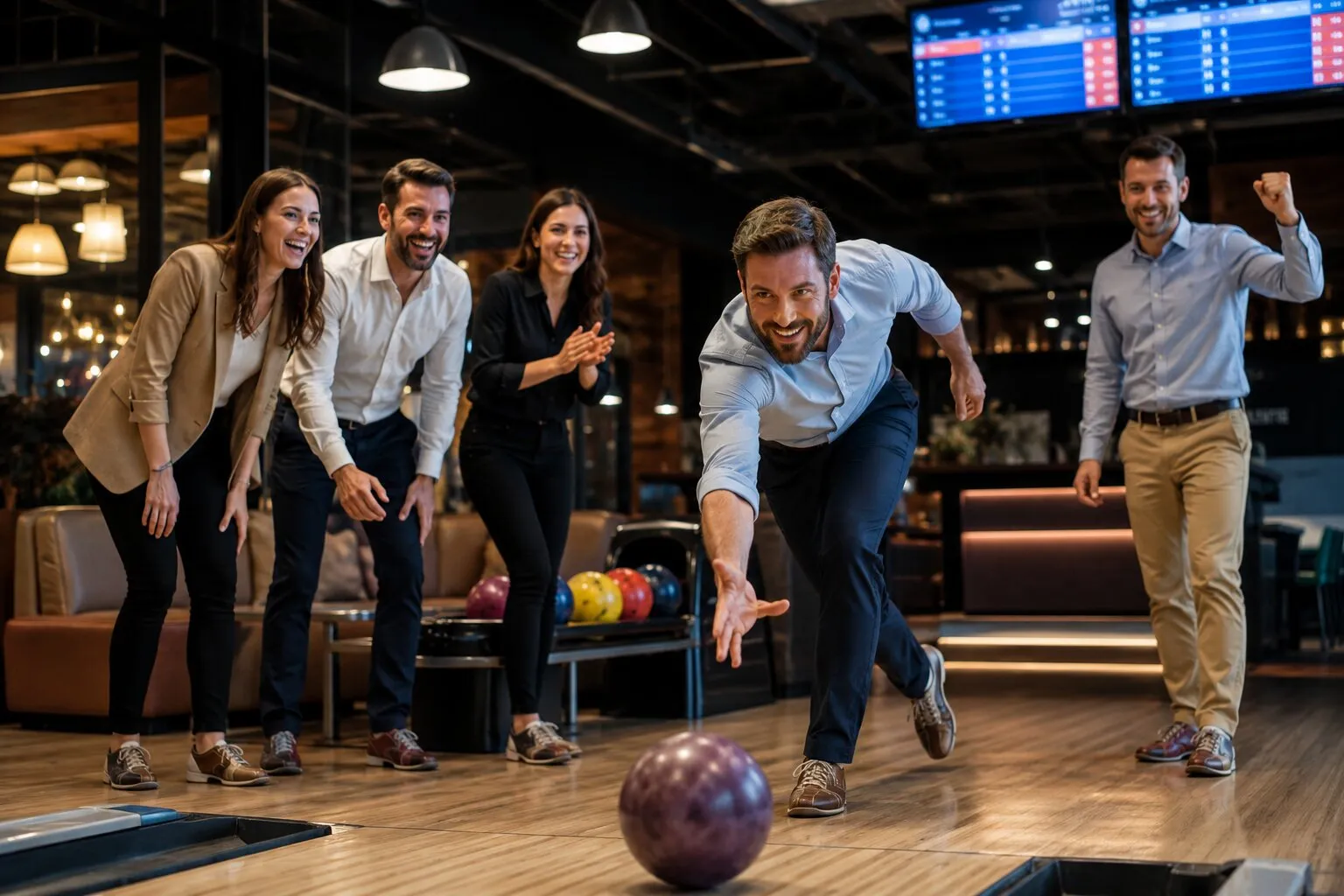
| Bowling / table tennis | No practical age or fitness limit; almost everyone has played before |
| Archery, darts, axe throwing | Skill-based; no advantage from strength or speed |
| Escape room | Entirely mental; requires no physical participation |
| Boules / pétanque | Low tempo, high strategy |
| Obstacle course (corporate version) | Balanced by the right to skip and team scoring |
| Pedal boats / canoeing | No technical barrier; swimming not required |
| Tai chi, stretching, breathwork | Standing or seated; ages 25 and 60 share a session |
| Sports festival / station rotation | Participants choose which station to take on |
What to be careful with in a mixed group
- Long-distance cycling and running: The speed spread splits the group within the first half hour. Do not run these without pace groups and e-bikes.
- Squash: The cardiovascular load is high; not suitable for a mixed group.
- Five-a-side football: The fit dominate and the rest never touch the ball. Short matches and compulsory substitutions are essential.
- Climbing and zipline: Fear of heights is independent of fitness; an alternative is mandatory.
- Paragliding, bungee: Health restrictions are significant; not a format to offer to a whole mixed group.
A note on age diversity
In corporate events, age is a more complex variable than fitness because it overlaps with seniority. A 55-year-old participant is often also a manager, and the fear of looking incompetent is higher in front of their own team.
This affects design directly: formats where everyone tries the same thing at the same time (a group lesson, a shared briefing) reduce that anxiety; formats where people take turns while everyone watches increase it.
Collect health declarations properly
This step cannot be skipped with a mixed group. In the registration form, yes/no format without asking for diagnoses:
- Heart conditions or blood pressure
- Pregnancy
- Recent surgery
- Back, knee or shoulder problems
- Mobility limitations
- Not being able to swim (for water activities)
This information stays with the event lead and is passed to the field team as an operational summary — "three people need a lower-intensity alternative" — rather than as a list of names.
The ideal structure for a mixed group: station rotation
For mixed groups of 50 and above, this works best:
- Set up 6–8 different stations (some physical, some skill-based, some mental)
- Teams rotate between stations
- A team score is taken at each station
- Within their team, participants choose where they will contribute most
The strength of this structure is that the fit person contributes at the physical station, the experienced one at the strategy station, the calm one at the aiming station. It produces a day in which everyone is useful — and with a mixed group that is exactly the goal.

Leave a Comment